
Simplicity Complicity - Part 4
The Grand Meta-Narrative

The Narratival Rupture
This is an essay on humanity’s relationship with stories.
Not just folk tales and fiction—stories are the frames through which we interpret experience, construct meaning, and navigate the world.
Stories are not conceived in a vacuum. They propagate by osmosis through family, culture, and society. Our personal narratives are nested within larger cultural ones. Across the field of stories—between people and communities—there are varying degrees of narratival continuity and rupture.
Just as the stories we inhabit may differ, so too can our ways of relating to them. There are varying degrees of narratival awareness—and different stances we take toward the stories we live by.
In this essay, we have built toward a particular stance—an evolutionary meta-narrative.
Along the way, we’ve challenged assumptions embedded in both modern mainstream culture and its postmodern critique. By investigating how these paradigms relate to stories, we aim to help readers determine their own stance.
Stories are the pivots on which both our individual and collective futures turn. By shaping the meaning we project onto experience, stories determine our responses—and the unfoldment of personal and collective history.
By investigating the nature of stories, we aim for nothing less than a renaissance of human authorship, reclaimed from both naivety and abdication.
Though some—and far too few—are already aligned, more or less self-aware, with the stance we’ve been building, we aim to make it explicit. We strive toward greater skill and care in humanity’s relationship with stories. Such care requires reexamining the stories our society runs on. Rather than merely describing it, we are outlining a practical path toward a mature, post-postmodern, meta-narratival stance.
Whether arising from within or absorbed from without, stories shape how we perceive, how we act—and consequently, how our futures unfold. Since our shared future hinges on this, we’ve taken the liberty of writing at length. As we near this leg of the journey’s end, let’s make sure to stick the landing.
Human Limitations
As finite, fallible beings, so much lies outside our control. Are our stories among them? It depends. Throughout human history, stories have been the implements by which some people controlled others—by monopolizing the power of authorship.
Authorship is our toolkit for working with stories—a prerequisite for true freedom. Reclaiming it is the only alternative to following someone else’s script—and living in narratival bondage.1
In a stultified form, this is already common knowledge. One is often told in postmodern culture: “You make your own reality.” But while we may make our own (lowercase r) realities, these co-exist within Reality, with which our realities—our stories—must align. Misunderstanding the role of stories relative to Reality turns this seemingly empowering statement toward delusion and fragmentation.
Therefore, our emancipation project begins by examining the nature and role of stories. We must clarify the limits of this power—for a story, after all, can be a misfit: failing to align with the Reality it claims to describe.
And while many more questions will surface in the process, by clarifying the limits of authorship, it can be reclaimed all the more powerfully.
Our culture is suffering from narratival fatigue. We’re bombarded by narratives with competing agendas—propagated by both misguided institutions and well-meaning citizens. Rather than piling on yet another story about how you should live your life or how we should reform society, we investigate the field of stories itself. Our aim is to empower readers to navigate the narratival seas with independent sovereignty.
What we will have achieved by the end of this essay is nothing less than an approach toward an unprecedented expansion of wisdom and power—a novel post-postmodern stance toward both stories and Reality, emerging from the dialectic between simplicity and complexity, as a triumphant resurgence of the Renaissance of human potential.
The Story So Far
In Part 1, we explored the dialectical tension between simplicity and complexity that plays out within each of us. Our understanding of Reality matures through metabolizing antithetical complexity—evolving from one story to the next. We project our story onto Reality, encounter contradiction, and must grow. This dynamic is at the very heart of a human being’s process of maturation.
In the transitional moment between stories, we find ourselves adrift in pre-narrated Reality, a liminal space between worlds.2
In Part 2, we examined modern history and recognized that society is now suspended in such a liminal moment. Humanity is rapidly awakening to the limitations of the modern grand narrative. But this recognition is not evenly distributed—it moves like a slow wave, reaching some long before it crashes down on others.
As this recognition slowly dawns on our culture, we find ourselves between worlds. Culture is pulled between the oversimplifications of modernism and the overcomplications of postmodernism.
In Part 3, we discussed the developmental pathways toward dialectical peace with both simplicity and complexity, ensuring that we do not harbor biases that distort the natural back-and-forth movement between the two through which human beings mature from one story to the next.
We concluded Part 3 by showing that only by first making peace with both simplicity and complexity can an impartial synthesis emerge. This presents us—the Pivot Generation—with developmental imperatives.
Now, with our philosophical, historical, and developmental preparations complete, we are ready to resolve the primordial tension between simplicity and complexity. And what else could the synthesis take but the form of a story? It is an evolutionary story of stories.
The dialectical tension between simplicity and complexity underlies the maturation process. We should not expect development to end while we are still moving through life. Instead of seeking to stop the motion—and prematurely capping our growth—we find a point of rest beyond it, one that embraces and directs the flow. We do not snuff out this existential tension, but learn to ride it like a surfer does a wave. The dance between simplicity and complexity is the pulse of our evolutionary story, pulling us toward better horizons.
Welcome back to High Resolution. This is Simplicity Complicity…
Part 4: The Grand Meta-Narrative
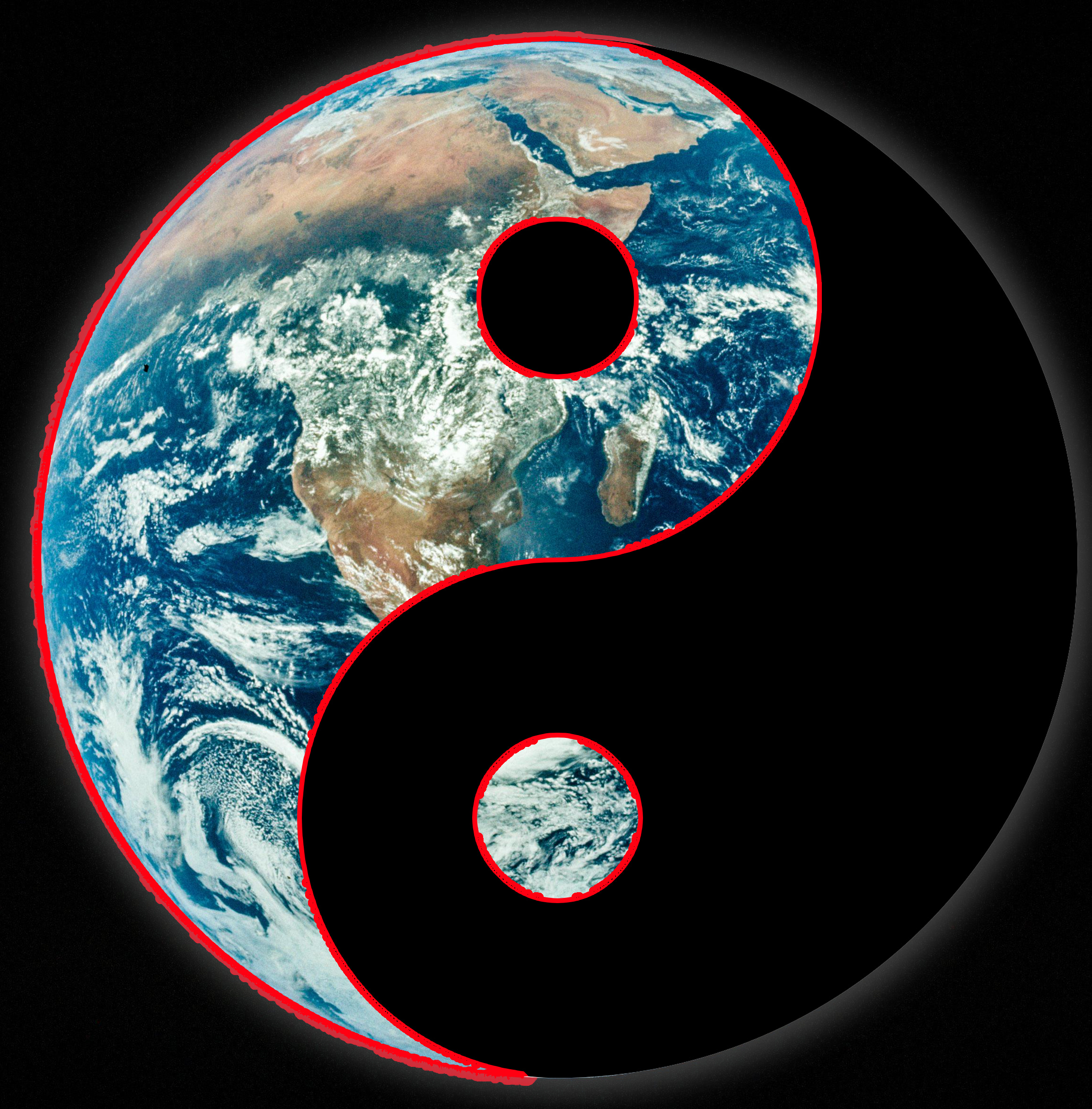
Humanity is under pressure to undergo rapid, unprecedented maturation.
Human immaturity bred stories that created an unsustainable situation—now rapidly coming to a head—and opened the door to truly horrific futures, following historical momentum and the dominant narratives at play.
Some of what’s coming can no longer be avoided. Still, to navigate what lies ahead—and shape it into a beautiful future despite all odds—we are called to evolve. For this, we need a story that aligns us with evolution.3(3) But as we’ve seen, evolution requires the death and rebirth of many stories. Can a story outlive its own death? Is this a paradox?
A new stance toward stories is needed. How we relate to anything depends on the story we tell about it. As painfully recursive as this may be, our relationship to stories themselves functions the same way: to change it, we need a new story about stories—a new meta-narrative.
As we’ve explored since Back to the Storyboard, stories are what the human world is made of—the fabric from which our shared world is woven. The objective world may be composed of particles—or some hypercomplex wave function4—but the subjective world we inhabit is made of stories.
Stories shape how humans perceive and act at every scale, from individuals to entire societies. In many ways, stories define the human being.
But whole societies can fall into their stories. We tend to forget that our stories are just projections onto Reality, not She Herself. Through this forgetting, the story becomes experientially fused—or (con-)fused—with Reality. Without a reliable meta-narrative, we get lost in the plot.
We take stories for granted when we leave them unexamined. This unexamined life—(is it worth living?)—is so culturally ubiquitous that an alternative may strike some like (or with) a mystical revelation. But there are better ways of relating to stories.
Just as, asleep in our beds, piercing the nature of the dream as dream allows for lucid dreaming, piercing the nature of our lived story as story allows for lucid living. We strive for a lucid humanity. To break the spell, we present the Grand Meta-Narrative.
The Grand Meta-Narrative (GMN) is the evolutionary story of stories—a post-postmodern stance that transcends narratives by situating identity beyond them, while still using them skillfully in service of a greater purpose: the beautiful future that only an evolved, self-authoring species can co-create.
Because the GMN fosters growth and a mature relationship with stories as a category, it is fit to meet our historically unprecedented moment of metacrisis.5 Our situation was created—and is maintained—by our stories. Whatever control we have over where we go will be determined by the stories we tell about where we are.
By maintaining a carefully balanced relationship with stories, the GMN acts as the unmoving axle around which the wheel turns—offering stability through the necessary dissolution and regeneration of stories, as we grow to better encompass complexity. The GMN pledges allegiance to Reality and to the principle of storytelling—not to any particular story.
The GMN grants us freedom to rewrite our stories—but only within the bounds of what Reality permits. Holding this balance is the key to grounded, responsible authorship through which we can shape our futures. In a moment as precarious as ours, given the power we now wield, mastering this balance may be necessary for humanity to have any future at all.
The Meta-Narratival Revolution
We need a healthy meta-narrative. By contrast, an unhealthy one stifles maturation by obscuring the significance or function of either stories or their dissolution—biasing us toward either simplicity or complexity. A healthy synthesis cannot deny or transcend either side but must engage with their interplay in a way that supports the natural life cycle of stories—from birth to death.
Humans easily get entangled in their stories. By clarifying “story nature,” we come to better understand human nature—our own and that of others. Disentangling from stories leads to compassion rooted in clarity rather than willpower. Forget trying to love thy neighbor. Pierce through the (con)fusion, and love will already be there, waiting.
When stories are seen for what they are, they are no longer demonized—nor are the people or cultures who’ve fallen asleep into them. Without a mature meta-narrative, this entanglement is inevitable. Meta-narratives determine whether or not we can leave our stories behind, by framing our relationship with any and all of them.
Such is the significance of a meta-narratival revolution. By elevating cultural discourse above the all-consuming details of competing stories—toward meta-narratival maturity—the deadlocks dissolve. Who will win the culture war? The war has only losers. It will fade into irrelevance as fewer and fewer people care about the scoreboard, having pierced through the confused nature of the struggle.
Anyone who—through sheer grace, hard work, or dumb luck—reaches a vantage from which the entire battlefield becomes clear, sees we’ve been fighting projected shadows all along, played by forces we were never equipped to understand.
Between Modernity and Postmodernity
In Back to the Storyboard, we differentiated between meta- and grand narratives.
The stories of modernism and postmodernism each lean to one side. We’ve explored deep issues with these paradigms—both theoretical and practical.
Simply put, modernity has (or is) a grand narrative—progress: Using our superior intellect, humanity will reshape the material world to conform to human needs and desires. Every selfish—or apparently greedy—innovation brings humanity (or at least one percent of it) one step closer to a safe, comfortable, and luxurious life. Hurray.
In contrast, postmodernism has (or is) a meta-narrative—relativism: All narratives are social constructs. This makes them merely subjective and equally arbitrary, including the modern grand narrative with its ostensibly objective ideas, metrics, and models.
A meta-narrative, even an implicit one, is always present. Modernity’s meta-narrative is rationalism: We have cleansed ourselves of dogma and are, for the first time in history, capable of rational thought. At last, we can deem all other stories childish superstitions. The technological superiority we used to subjugate them proves it.
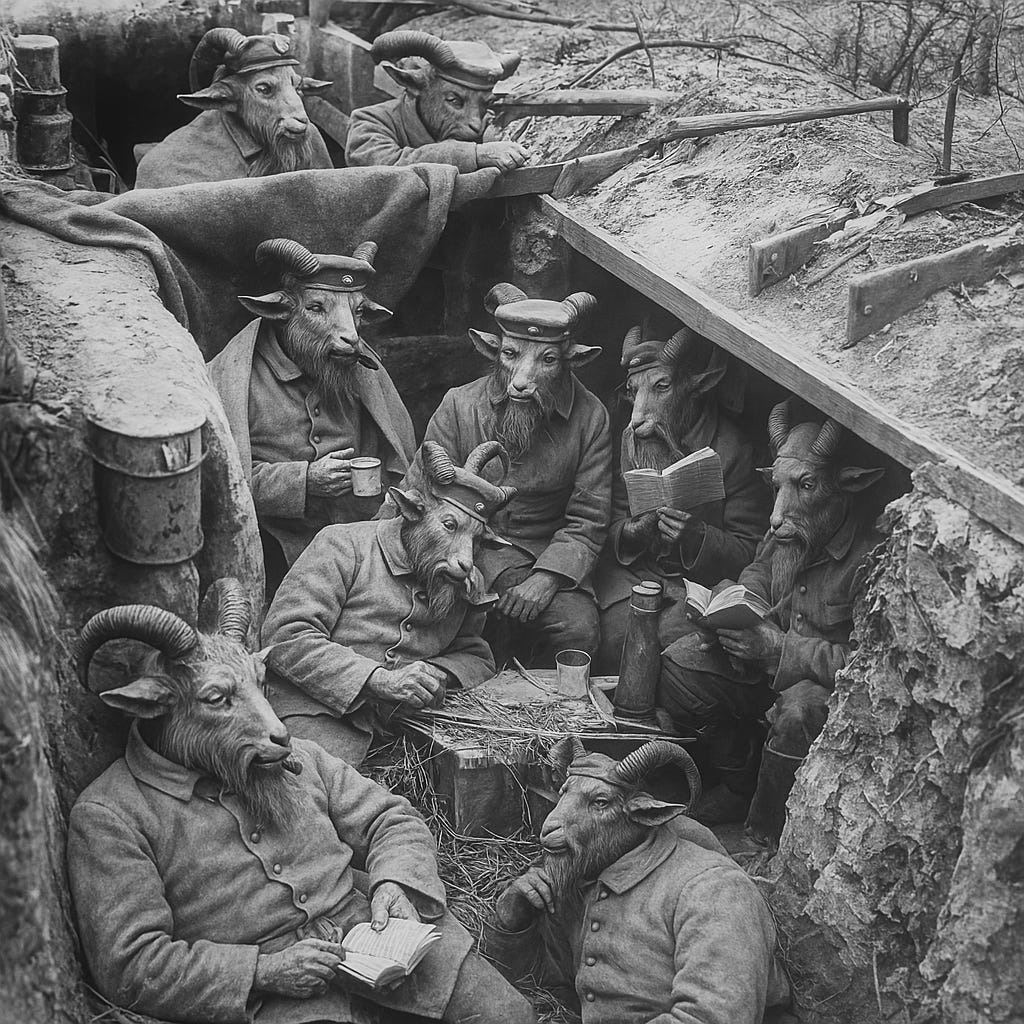
We can discern a de-facto postmodern grand narrative—nihilism: We project our arbitrary meaning onto a meaningless universe. Our delusional, grandiose species was doomed the minute it started talking to itself. Had the goats evolved to achieve self-awareness and symbolic language before us, capra sapiens would have fought industrial world wars and developed nukes instead of the apes.
Modernism, reacting against the narratival hegemony of Christian dogma, lacked the context needed to develop a self-reflective, pluralistic meta-narrative. In turn, postmodernism, recoiling from modernity’s excesses, became categorically allergic to grand narratives, leaving nihilism as a meaning-denying default in a narratival void that refuses a vacuum. Both movements developed reasonable responses to their respective contexts.
So be too quick to knock down “dead white male philosophers.” The holes in their paradigms were inevitable considering the backdrops on which they worked, and can only be filled by us with the benefit of hindsight.
Beyond Modernity and Postmodernity
New stories must understand both of these legacies—and their issues—and rescue both babies from the now-toxic bath water. Though we take a critical tone, post-postmodern movements are picking up the trampled banner—and the valid essence—of both the Western Enlightenment and its postmodern critique.
Such is our history (or, at least, that of the modern West). Instead of lamenting past mistakes, we strive to learn from them.
The stories of the past still carry momentum in the present and play their parts in the complexity that is ours to grapple with. The culture war between modernism and postmodernism siphons off the energy and attention needed for effective discourse or novel ideas capable of revealing a path forward in our complex, planetary moment of crisis.
While modernism is an adolescent’s story on many counts, being a grand narrative, it provided collective orientation for society. For better or worse, modernism proved unprecedentedly effective at remaking the world in its image. If we wish to be effective at scale, and we may have to be, we need a grand narrative.
But having unveiled the constructed nature of stories through the postmodern critique, we can no longer naively swing around a complexity-blind grand narrative. If we wish to be able to wield stories responsibly, we need a meta-narrative.
So, what does a story that fits our situation and needs look like? Is it a meta-narrative or a grand narrative? Which will it be?
Clearly, it must be both.
The Grand Meta-Narrative
Let us revisit for a moment how we set off on this journey in Part 1.
Existence is a mystery. The Reality into which we are plunged at birth is a mystery. Human culture, among other things, is a collective attempt to make sense of Reality—and of existence.
Those who suspect their culture is failing at this task face the grave responsibility of separating its truths from its prejudices. This was as true for the thinkers of the Western Enlightenment as it was for the postmodernists—as it is now for us.
In light of this gargantuan task, our first move—back in Part 1—was a bow of humility to Reality Herself.
Epistemic Humility Versus Epistemic Hubris
Epistemology is the branch of philosophy concerned with questions of knowledge: How can we know? What does it mean to know?
Postmodern philosophers contended with a modern society that presumes to have found an objective stance from which to determine what is true and how society should be oriented. To thoroughly invalidate such epistemic hubris, postmodern thinkers wrought relativism. Relativism should be understood as an extreme postmodern stance meant to counter the quasi-objectivity of modernity. It does so by stating that all stories are completely subjective and, lacking any shred of objectivity, are equally arbitrary. With this move, postmodern thinkers undermined modernity’s self-justification.
But stories—though clearly social constructs—are humanity’s meager means of describing and navigating a hypercomplex Reality. This alone already counters relativism. How so?
If Reality wasn’t there, patiently waiting for us to get our act together, relativism would have been a foregone conclusion—all our stories would be free-floating subjective constructs. But the dialectical nature of stories ties them to their dance partner: Reality. Relativism quickly disintegrates once we recognize that stories serve a function in relation to a Reality beyond them—one they aim to describe. Some, accordingly, better match the complexities they simplify.
If one accepts this as the role of stories, the only way to counter our argument is to question the existence of Reality. We’d rather argue with empty bar stools than entertain such clownery.
By beginning our journey with grounded humility, we distinguished early on that our perception of Reality and Reality Herself are of two entirely different orders. One is simple—constructed by us and limited by our fallibility. The other is hypercomplex, preexisting, and inclusive of us and all our constructs.
It’s not that human beings are not complex. But we are limited. We need to simplify our situation to navigate it. In doing so, we also simplify ourselves and others.
The Characters We Play
By simplifying a complex Reality into stories, we simplify human beings into characters.
We’ve repeated in several ways that people can fall asleep into narratives—or become entangled in them—and that the unexamined story becomes experientially (con)fused with Reality. How does someone who sees the world through the lens of a story see themselves?
According to our story, we relate to the world. By defining the world, we determine our own place in it. This turns a story into a self-world diad—by defining one, we constrain the other. Reality is simplified through narratives, and in these we play our parts. We cast others into roles according to our stories, simplifying them—in our experience—to our level of understanding. And we do the same to ourselves.
Being entangled with a story implies identifying with a character within it. This character—one’s conceptual self-image—is often referred to, in psychoanalytic terms, as the ego: the mental construct with which one identifies.
Because we tell many contextual, often interpenetrating—and even contradictory—stories, the self-characters within them are better understood as ego-fragments, rather than as a whole, self-consistent, context-independent entity. Our sense of identity arises from the characters we assume in our stories. Much can be (and has been) said about the psychological precariousness of this condition.
The Hero’s Journey
The essence of Joseph Campbell’s monomyth—the Hero’s Journey—is the plunge from simplicity into complexity, from the known into the unknown, and back again—renewed—to stability, as the ordeal is resolved.
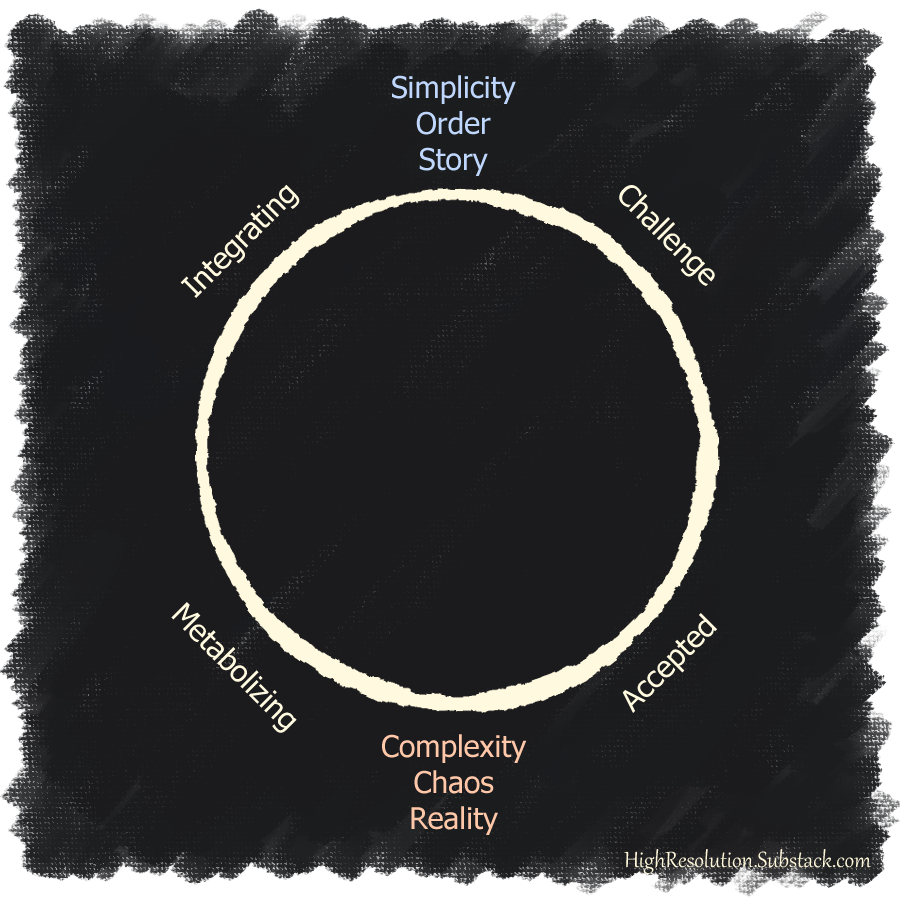
Though the Hero’s Journey can be told as a story, the would-be hero already lived within one before the journey began. The journey actually describes the dissolution of a story-world and the process that leads the hero beyond it.
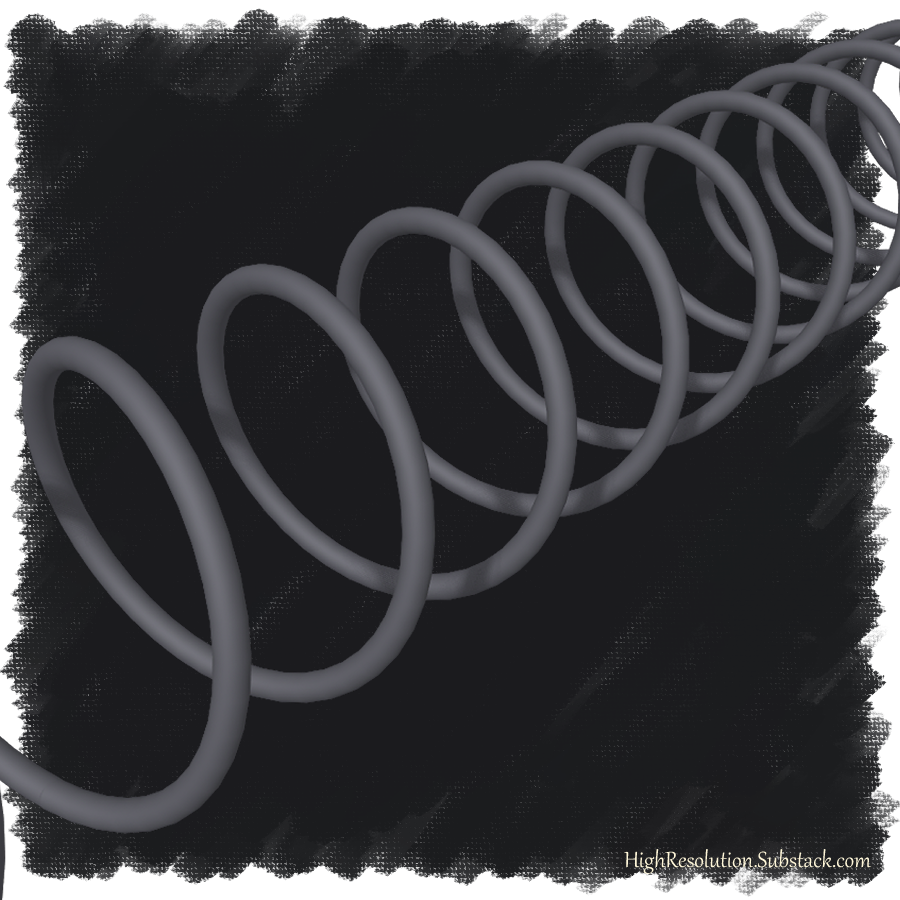
After the descent into complexity and chaos, the hero’s character is reborn—renewed and matured. Having metabolized the complexity, they emerge into a new story-world—more robust and encompassing. The image of the circle fails to capture this, as it appears to end the journey exactly where it began. But from a different angle, the circle reveals itself to be a helix.
The Locus of Identity
We project our stories onto Reality—and live according to them. In such cases, identity becomes bound up with the character we play. This is where the would-be hero begins their journey: with identity centered in the simple story they know.
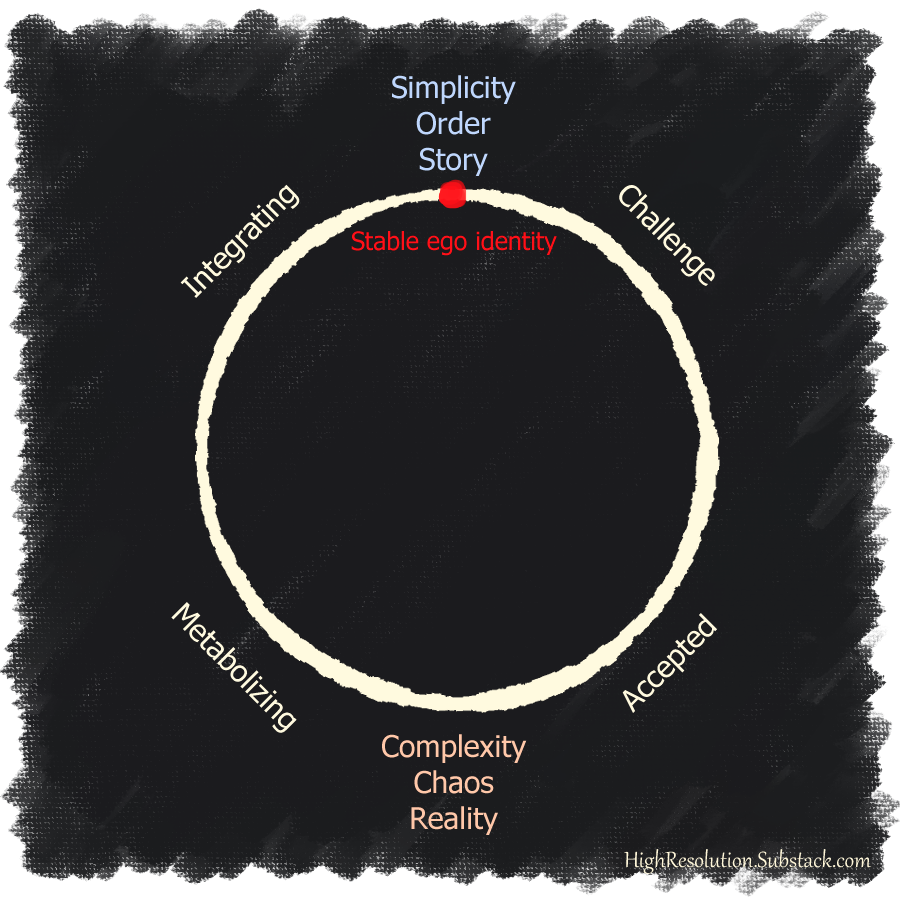
How might we illustrate the developmental biases on this diagram? The simplicity-biased resist metabolizing the complexity of Reality when it contradicts their narrative. As cognitive dissonance rises, they double down—reframing contradictions to fit their story. In dire circumstances, they may be washed away by a tsunami. In calmer times, they preserve their psychospiritual stagnation. But denying the rejuvenating, transformative flow of life in favor of familiar safety comes at the cost of health, vitality, and relevance.
The complexity-biased, by contrast, venture into chaos but fail to return. Unable or unwilling to metabolize what they encountered and commit to a new story, they remain suspended in limbo.
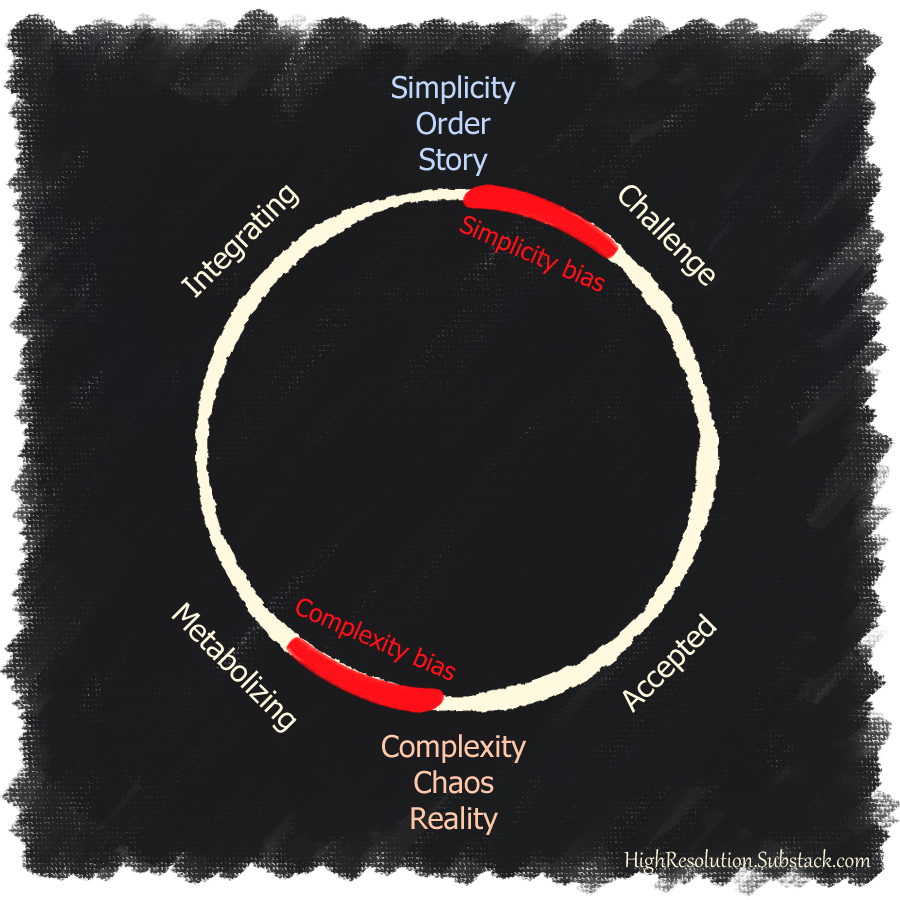
The archetypal hero, by contrast, ventures into the unknown—courageously surrendering their old self and embracing transformation by answering Reality’s call to grow. The hero rides the helix—staying with the process and shedding juvenile parts no longer suited to life’s newfound complexity.
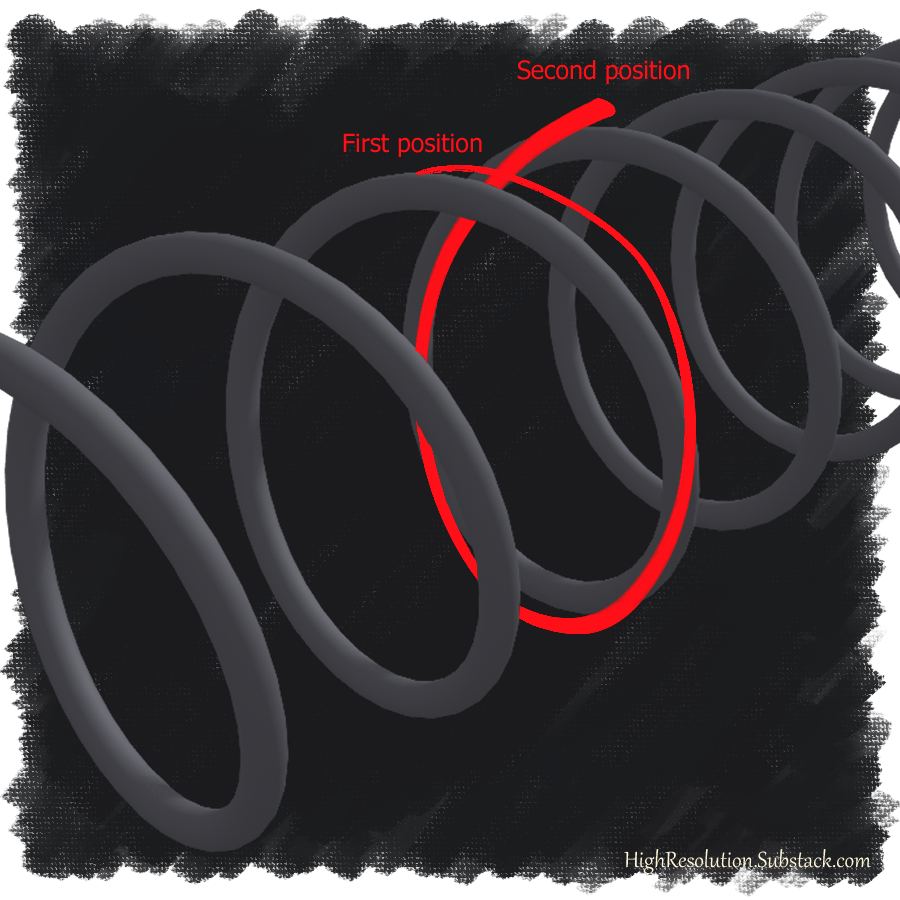
Through repetition, a realization may dawn on the ever-looping hero. Reflecting on the dizzying cycles of past transformations, another path begins to reveal itself. The hero may discover a new depth of wisdom to match their courage—by taking the hidden path toward meta-awareness of the journey itself.
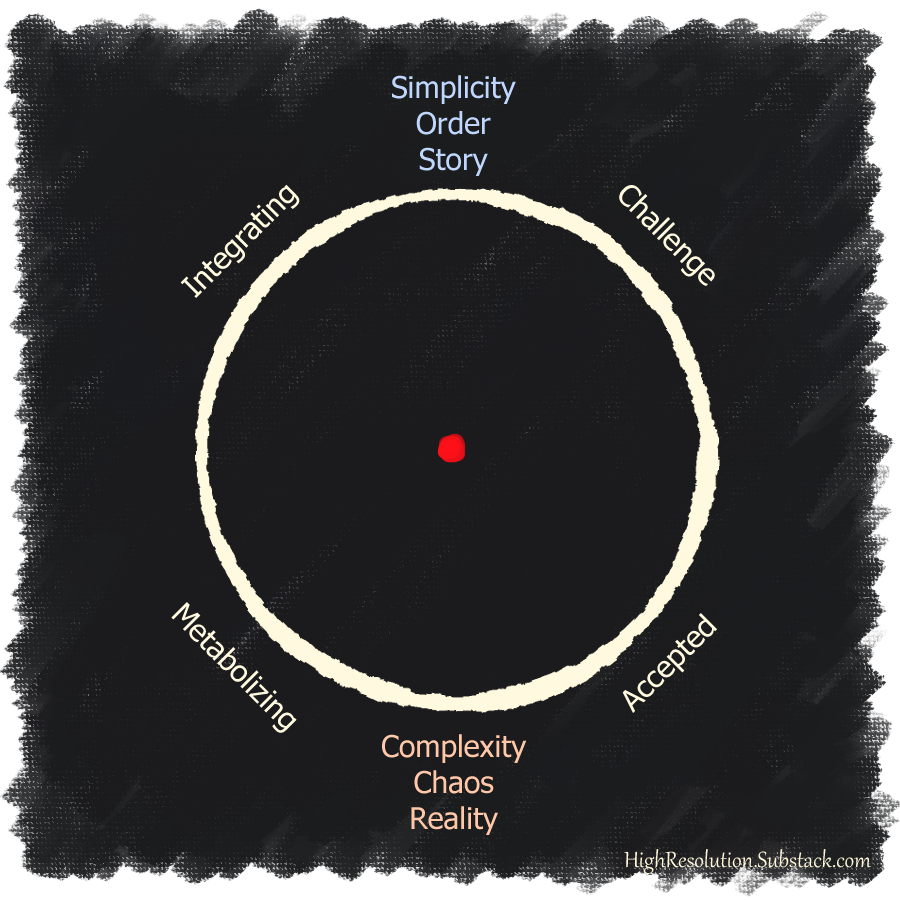
To see the structure of transformation is to step outside it. The GMN is a story of stories—one that enfolds the Hero’s Journey, thereby offering a radical shift in identity. How does the hero integrate the structure of transformation itself? In this act, we find the GMN’s locus of identity.
Or:

In the GMN, identity is no longer derived from any passing story, but grounded in a mature meta-narrative. Transcending the structure of story itself, we realize we are not merely characters within one—the transformation of the ego no longer poses a threat. From this position, we can read the winds of change and ride the currents of evolution.
Healthy Distance from the Ego
The GMN grounds our identity in a psychologically stable position beyond the character and its tenuous story-world. Disidentified from the ego, yet not disavowing it, we allow it to change while remaining grounded beyond it. This is the potential of mature meta-narratival awareness—the result of not fusing Reality with story, or identity with character.
By contrast, in the ego-fused psyche, contradiction of the story-world feels existential. Without psychological stability beyond the story, it is experienced as a death threat. And so, evolution is reflexively resisted.
Only by stepping outside the ego and its story-world—into a stable psychological position beyond such temporary constructs—can we engage with complexity freely.
Conversely, disavowing the ego—or attempting to “kill” it—is a denial of the necessity and role of stories. With no effective simplification for navigating Reality, one is paralyzed. Even if one succeeded in killing their ego, another would rise to take its place—like a hopeless game of self-negating whack-a-mole. Forcibly suppressing the emergence of narratival frames can be destabilizing and life-denying.
By affirming the necessity of these constructs—story and character—yet holding them at a healthy distance, we gain the freedom to integrate complexity.
By gaining this space—the right distance—we are enabled to choose a path forward. This space and distance allow for the compassion, patience, and perseverance needed for lasting change. With this, self-development is no longer a reactive process—it becomes deliberate, effective, and enduring.
The Evolutionary Meta-Narrative
As a meta-narrative that aims for the right distance from stories—not too far, not too close—the GMN acts as an evolutionary accelerator.
Rather than fighting the ego on one hand or confining ourselves to its story-world on the other, the GMN offers a clear and meta-aware alternative.
With distance from the character and the story, coupled with an appreciation of their role, we can continually cultivate healthier and more mature egos, guided by a deepening understanding of Reality.
This outlines a healthy relationship with both stories and Reality, which requires the right footing. In other words, the right meta-narrative. The GMN is a psychologically stable position from which to navigate this process.
As we continuously metabolize complexity, our stories become increasingly grounded in Reality. The alternative would risk having our stories drift from Reality. Only by committing to this process can we responsibly commit to a story—albeit temporarily—and apply power according to it. The GMN reveals how we can confront the complexity of our situations fully and commit to a plan of action.
Can power unbound by this process be justified? Can it be wise? By avoiding Reality, we oversimplify complexity and operate based on a delusional story. But on the other hand, can the avoidance of power be justified? It is the abandonment of responsibility for co-creating the world.
The GMN resolves this tension, giving us a glimmer of hope for the future. It justifies power by binding it to wisdom sourced from grounded epistemic humility. It grants power to the wise and wisdom to the fool.
Conclusion
The Path Ahead
The GMN offers a path forward for a humanity struggling to make sense of—and navigate—an increasingly complex situation.
In this complex and dramatic historical moment, society cannot be mobilized toward sensible action without a mature post-postmodern meta-narrative. Even individuals cannot effectively navigate the complex world we created without one.
The complexity of our situation stems from two sources. The first predates the rise of oversimplifying civilizations—the earliest known empires. This endless category encompasses biology, psychology, ecology, metaphysics, and much more than human understanding has ever encompassed.
The second is anthropogenic: the complexity we’ve added into the mix—culture, society, and their cascading externalities.
This latter complexity only becomes problematic when it stems from an oversimplification of the former. When did human society go astray? Simply put: when we lost harmony with nature. When our stories ceased to align with the full complexity of Reality, we began accruing narratival debt.
Societies built on foolish stories inevitably collapse. History is full of examples. Ours is an extreme case study—leaning with unprecedented epistemic hubris and industrialized potency into modern simplifications of Reality. These plans and schemes—narrow in goal, myopic in framing, and blind to externalities—share a common pathology.
Yet many are already living by the principles outlined here—committed to honoring the complexity of the situation while striving for agency within it. They navigate the dialectic of simplicity and complexity with care and wisdom. And many already maintain a healthy distance from their egos. For such people, this essay may offer common language, reasoning, and clarity around a familiar terrain. For others, it points the way forward.
Authorship and Leadership
We are moving beyond Simplicity Complicity—not just as an essay, but as a sociocultural pathology—by evolving our relationship with stories.
Agency, power, and freedom—bound by wisdom and a humble, honest approach to complexity. Psychological stability beyond character and story. Meta-narratival awareness. An evolutionary synthesis of simplicity and complexity. A lens for understanding our culture’s inner conflicts through the dialectic. This is what this essay set out to illuminate. Now, the real work begins.
Equipped with a map, it is up to each of us to engage with our own stories—whether inherited or self-authored—at a pace appropriate to our unique context. A map is helpful, but it cannot replace the journey. We are each called to integrate a mature meta-narrative within our being—empowering us to challenge our conscious narratives and excavate the fragmented, subconscious ones that call for integration.
From this stance—no matter the path taken—we may come together again as lucid human beings, undivided and unlimited by adolescent stories. When wise heroes come together to reckon with the complexity of our time, the path will be revealed. When wise heroism becomes the norm, the path will be walked.
Where Do We Go From Here?
A story is a simplification—one we must construct in order to navigate complexity. The GMN empowers us to do so with clarity, intention, and care.
But—navigate? Navigate where, exactly?
At this point in the story, the GMN can be misappropriated for just about any purpose. Reality is complex. Fine. And I will metabolize the complexity to bolster my stock portfolio. Or take over this nation-state. Or become a better pick-up “artist.” In the shadow of the GMN will gather its shallow interpreters—those who venture only so far into the complexity of Reality—and of themselves. They may generate narratives that effectively navigate Reality while retaining a core piece of their ego to which they are more loyal. A more honest application of these principles challenges such self-deception. Still, the question remains.
The GMN allows for unprecedented movement forward. But which way is forward? The GMN can answer the question “what is the best way to navigate Reality?” But navigate it to go where? Where do we want to go? Suppose we could create any society we want—so long as it is grounded in Reality. What kind of society would we choose to create?
A post-postmodern meta-narrative that fails to help us examine our values does worse than leave us foolish, making us dangerously powerful.
This is the end of Simplicity Complicity. To leave our oversimplistic narratives behind, we could not make do with a new simplistic grand narrative. Instead, we presented the Grand Meta-Narrative—a post-postmodern meta-narrative fit to guide individuals and societies through the complexities of our time. From it, we can generate and dissolve ephemeral but grounded stories, as the situation demands. Coexisting with stories, refining them as needed, the GMN continually moves toward greater coherence.
Now, empowered and freed from simplistic grand narratives—with destiny reclaimed from outdated ideas—we must be more careful than ever in answering: where do we truly want to go?
The GMN’s higher purpose is to arrive at a convergence of humanity’s fragmented stories toward empowered collaboration. Being fit for this task puts the G in GMN. This purpose will continue to unfold along High Resolution’s life cycle.
We are energized and inspired by where we’re heading—and by the undeniable glimmer of potential that lights the way. Nevertheless, we have not force-fed our readership our story. First, we established a post-postmodern meta-narrative to empower and equip others to navigate the field of stories alongside us.
We can bring about a beautiful future. To the extent that our stories align with the complexity of Reality, the future will take shape according to our intent. Recognizing the gravity of the power we now hold, we are called not to accelerate—but to slow down.
How can we be sure the direction we’re traveling isn’t skewed by trauma, or shaped by inherited, unexamined, unworthy goals? Understanding that, within the limitations of Reality, we can create the future, we must take responsibility for what future we choose. The next leg of our journey comes into view.
By now, the unapologetic ambition of this fledgling publication is becoming clearer. That we can take big, powerful steps is one thing—but where, exactly, are we going?
Stay tuned to High Resolution as we take the next step on the long road to a truly beautiful future—right here on Earth: the clarification of values.
May we become better students of Reality
May we recall our humility
May we learn how to listen
May we become better stewards of stories
May we resume our posts with vigilance
And reclaim the reins of destiny
May human culture be healed through our efforts
May future generations sing with gratitude to their ancestors:
We—lost souls now found—the Pivot Generation
Though we use strong language here, narratival dependency is entirely appropriate—at least early in life. This dependency is to be gradually outgrown in early adulthood. As a speculative side note, consider that in other, hypothetical civilizations, healthy development might require fewer rebellious maneuvers. In other words, it is a peculiarity of our times that demands one distance oneself from inherited narratives in order to mature.
We adopt this term from Zak Stein’s Education in a Time Between Worlds and use it similarly—to describe the historical liminal moment of transition between grand narratives and the societies they shape.
By evolution, do we refer to Social Darwinism? Eugenics? Cyborgian transhuman fantasies? Superior, silicon-based “life?” For now, we answer all these misappropriations of evolution [spoiler alert]—not if we can help it. We will discuss potential directions of evolution in our next essay.
Problematizing modern metaphysics is beyond the scope of this essay. For our purposes, it suffices to note that both modernity and postmodernity rest on a materialist ontology—Reality is made of matter (whatever that means). Were this foundation to collapse, the edifices of both would fall with it. Whatever would remain is nevertheless worth salvaging.
The term metacrisis refers to the interconnected nature of the multiple crises humanity now faces as a consequence of the society we’ve created. It elucidates that our situation cannot be addressed through isolated, narrow-boundary problem-solving—the very mode of thinking that generated the metacrisis to begin with.