
Simplicity Complicity - Part 2
The Modern Story and its Fallout

Where We Left Off
We began with a prelude, Back to the Storyboard, where we explored the significance of stories in shaping the human world and the future of our planet. We distinguished between grand narratives and meta-narratives, then began examining the nature of stories in this essay-in-parts, Simplicity Complicity.
In Part 1, we introduced the core concept: Simplicity and Complexity exist in a dialectic tension within every human being. Individually and inter-subjectively, humans cohere around narratives—simplifications of Reality’s otherwise overwhelming complexity.
But every story is a temporary construction. It may serve us well for a time, but its usefulness has limits. Eventually, we must leave old narratives behind and confront the complexity beyond them.
(Post)modern culture and society lack a mature way of relating to this dynamic, resulting in sociocultural blind spots of incredible magnitude.
The gap between the simplistic narratives that guide society and the complexity of Reality has made modern civilization unsustainable. While not universally acknowledged, the big picture reveals that we are entering an era of unprecedented transformation and upheaval as modern civilization collapses under the weight of its simplicity-complexity mismatch.
The word collapse is loaded, often provoking knee-jerk reactions. Unlike Hollywood-style disaster porn, which evokes unrealistic imagery, collapse unfolds in a series of phases and cascading crises. It is not an event but a systemic process—one that is already underway.
Will humanity survive beyond modernity? What will our future beyond modern limitations look like? To navigate the transformations ahead—and to shape a future worth living in—we must transcend our culture’s limitations and develop a more intentional relationship with stories.
We need new, better stories to address the consequences of our old ones. Before we move to shape the future, we need to understand how we got to the present situation by examining our past. We must examine how the dialectic between simplicity and complexity shaped modern history.
Part 2: The Modern Story and its Fallout

…Where we examine how the dialectic between simplicity and complexity played out in modern history.
The Liminal Space Between Worlds
In any historical epoch, most people take their culture’s assumptions for granted, having never encountered alternatives. This is a natural stance for those born into a stable, well-functioning society.
Making sense of Reality is typically a slow, intergenerational process. A grand narrative endures as successive generations inherit and interpret the world through its lens, carefully adapting to better meet changing circumstances.
But at certain historical junctures—periods of rapid transition between epochs—a culture’s narrative can waver, revealing its fault lines to those paying attention.
Through these sociocultural cracks, new ideas shine through, inviting us to imagine a different future. Those who dare to peer through the cracks may catch a glimpse of the new age to come.
Modernity itself began as such a glimmer—full of promise and hope—shining through the fractures of the Christian grand narrative in late medieval Europe. But before we go there, let’s clarify:
What is ‘Modern,’ Anyway?
From the Latin modo (‘just now’), modern literally means ‘current with the times,’ marking a break from the past. The term was used to distinguish the European Enlightenment—the age of reason and science—from its Christian predecessor, just as, roughly a millennium earlier, the Latin modernus had been used to differentiate Christianity from the so-called ‘pagan’ world it replaced.
But today, the meaning of modernism has grown ambiguous. Whatever current with the times means in 2025, modernism still refers to a centuries-old paradigm shaped by the European Enlightenment, even as its relevance fades. This has led to the rise of postmodernism, signaling cultural fragmentation and a growing recognition that modernity itself has lost track of the cutting edge. Increasingly, it is clear that what we still call modernism—the rationalist worldview of the Enlightenment—is being outpaced by new paradigms better suited to our historical moment.
At its core, modernism is defined by faith in (particular forms of) reason and science and the assumption that Reality can be understood, predicted, and controlled through human ingenuity for human benefit.
This belief system fuels a specific vision of modernization—one that seeks to industrialize production, standardize human life, and insulate civilization from the uncertainties of nature. Though this notion of modernism is wavering, it does not seem ready or willing to simply retire, and is instead preparing to put up a bitter fight to hold on to its hegemony.
And so, we find ourselves in an ironic predicament: the paradigm known as modernism is no longer modern. The cultural frontier has moved beyond it, but the inertia of modern institutions and narratives carries tremendous momentum.
How did such a hegemonic notion of modernism—hiding its age and decay under a thick coat of mass-produced, vaguely toxic petrochemical makeup—come to so thoroughly dominate the human world?
The Escape from Premodernity
Before the Renaissance and the Age of Enlightenment that followed, for over a thousand years, European society lived within a Christian grand narrative. God descended from Heaven to walk among mortals in human form, relieving humanity both from ambiguity about the nature of Reality and from an eternity in hell for the sin of being born into a human body. The Church fused with the bureaucratic structure of the Western Roman Empire and took it upon itself to interpret the meaning and significance of the life and death of Yeshua and to establish an anno Domini European society.
A grand narrative shapes how a culture sees Reality—its shared story—an attempt to simplify and make sense of Reality's complexity. (See Back to the Storyboard for more on grand and meta-narratives and the distinction between them.) The Christian grand narrative provided a unifying moral framework for Western Europe, offering stability and orientation in the chaotic aftermath of the Western Roman Empire’s disintegration in the 4th and 5th centuries CE.
Like other monotheistic and state religions, Christianity is a social structure that essentially says: “God, in His grace, disclosed to us the true nature of Reality. Forget trying to figure it out on your own like some mad heathen—just follow this list of rules instead.” Theological disputation aside, in a world otherwise steeped in chaos, this approach has some merit. Religious social structures such as the Church attempt to cohere society around a shared, absolute story—codified, institutionalized, and passed down with minimal change through generations.
The Church, fused with the remnants of the Roman Empire, upheld its hegemonic narratival hold on Europe by force—wiping out pre-Christian ‘pagan’ wisdom and suppressing the emergence of ‘heathen’ claims to truth (whether mystical or empirical) that threatened the Church’s monopoly on truth. For better or worse, the church maintained a tenuous social stability and common grand narrative in Europe for many centuries.
However, with the dawning of the Renaissance movement around the 14th century, winds of change were blowing through Europe. The Renaissance was a reemergence of classical philosophy, secular art, and scientific curiosity, rekindling a vision of individual human potential in the European mind. This laid the groundwork for further transformations to sweep through Europe. The advent of the printing press brought about a proliferation of translations of the New Testament. This allowed more people to bypass the Church’s middlemen and read the New Testament directly, leading to the Protestant Reformation, which definitively marked the beginning of the end of the Catholic religious monopoly in 16th-century Europe.
As the Church’s absolute hold on religious truth in Europe wavered, a secular movement found an opportunity to fight for the legitimacy of its own claim on truth—The European Enlightenment. The printing press that enabled the Protestant Reformation democratized knowledge, advancing the idea that individuals can use their own rational faculties to make sense of Reality without authority or dogma—rationalism. Out of this notion, a secular, empirical, and rational method of inquiring into the nature of Reality arose: Science.1 It proved its legitimacy practically—through its power to predict and control the material world.
Instead of deferring to religious doctrine and authority, the Enlightenment's empiricism and rationalism attempted to reduce Reality’s overwhelming complexity into empirically supported hypotheses, equations, and models. Individualistic, secular, and rational, the European Enlightenment birthed modernity.
Enlightenment thinkers argued that Reality could be comprehended by human intellect and bent to human will. As rationalism and science gained ground, the Church’s hegemonic authority waned. The material domain—subject to the empirical investigation of Western science—gained prominence, and the Western world became increasingly materialistic, stripped of notions of God, sacredness, telos, and meaning.
Meet Modernity
Enlightenment thinkers saw hope in freeing society from the dogmas of the Church. Instead of subjugating themselves to an invisible deity and the rules of His self-appointed representatives on Earth, they placed the reasoning capacities of the free-thinking individual as the rational authority for making sense of Reality.
They envisioned humanity on a quest for legible Universal Truth through rational investigation. Reality and nature were supposedly exposed as decipherable and controllable through the equations and models used to simplify them. They believed this revealed a rational path that would lead to a utopia of knowledge and convenience for all mankind.
From this story sprang the scientific and industrial revolutions. From it emerged individualistic, secular social systems—capitalism and modern democracy.
What began as a Cartesian split between spirit and matter led modernism to dismiss everything unobservable and immeasurable as primitive, superstitious fantasy. Modernism perceives Reality through Newtonian mechanics atop Cartesian coordinates, positivistically asserting that “if I can’t bump into it, it isn’t real!” It is only concerned with the material realm and sees the universe as a mechanical contraption. It creates isolated experiments on matter and extrapolates the behaviors it measures to theoretical models. These are then instrumentalized (or weaponized) by modern industry for the sake of power and profit.
European modernizers criticized the unsubstantiated dogmas of the Christian grand narrative. In contrast, every novel technological and scientific achievement seemed to support the modernists’ assumptions about the nature of Reality. Their proof? Simple: Power over matter.
Modernism seeks to break down and reduce Reality into understandable, predictable, manageable bits, equations, and models. It excels at understanding and building complicated systems—comprehensible systems made of simple building blocks, like a toaster. But it struggles with complex systems that defy comprehension and control, like a duck.2 Modernism recoils from complexity, attempting to reduce it to something simple enough to manage.
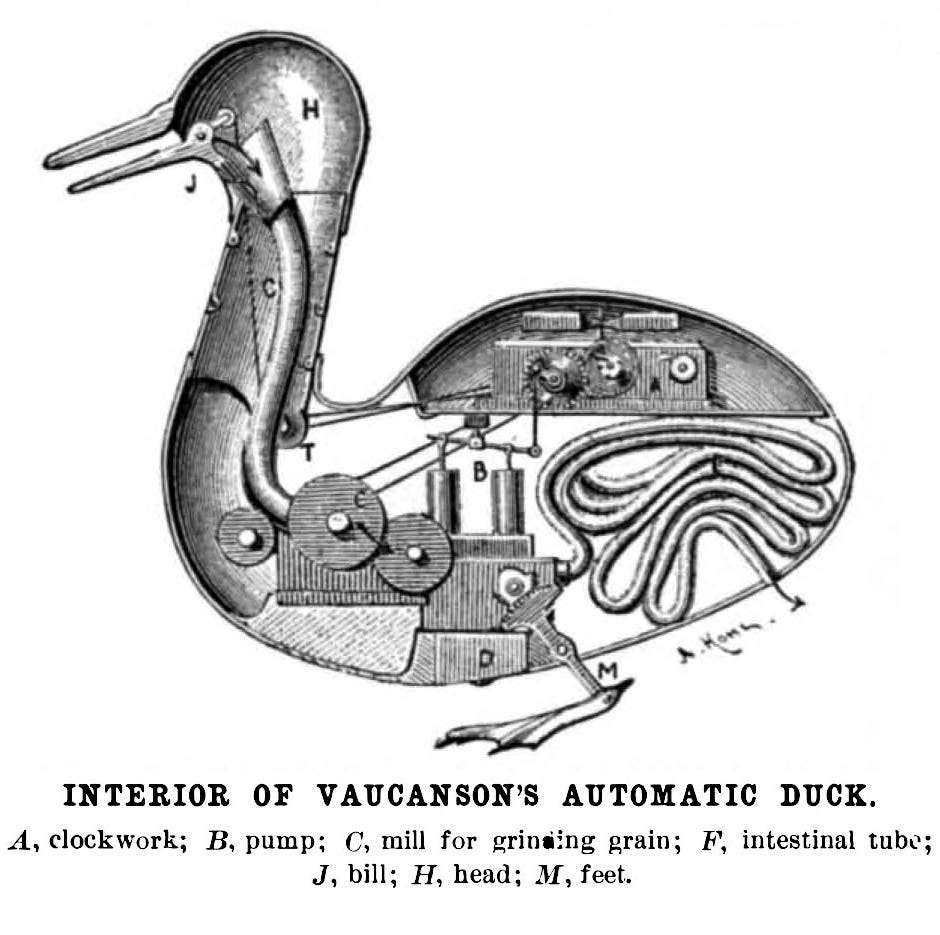
Instead of holding its models as useful tools, modernism became enamored with them and increasingly came to perceive Reality through them, thereby confusing the map with the territory.
Modernity sees Reality as random, arbitrary, material chaos. As a statistical byproduct of the sheer size of the universe—through the chance interaction of particles and the self-selection logic of Darwinian biology—life and a self-conscious species came to exist on Earth. Modern cosmogony in a nutshell.
It would be hasty to dismiss the potency of the modern narrative. Putting aside whether its story aligns with the nature of Reality, modernism was highly effective in instrumentalizing its discoveries regarding the material realm. What does history tell us about what the modern world did with its newfound powers over matter?
Modernism seeks to simplify Reality to control Reality. According to this worldview, the right models and equations enable us to manipulate matter, and this should somehow prove our comprehension of Reality. This armed the European conquerors with a novel justification for conquest—it’s all humanitarian! Declaring that they had the answers to the universe’s mysteries at the tips of their measurement devices, European powers fashioned a new power hierarchy that placed industrialized secular societies at the pinnacle of human evolution and moved to enlighten the ‘savages’ of the Americas, Africa, Asia, Australia, and everywhere else in between.
Modernism continued its march, moving to simplify and standardize the whole planet—through conquest.
The Total Empire
Modernism measures its validity through its power over matter. It was not born in a vacuum but in the tumultuous climate of an unstable, competitive, power-game-oriented Western Europe.
Western modernism is a direct descendant of empire culture, seeking to restore (or surpass) the glory of Rome, idealizing Caesar and Alexander ‘the Great.’ It harnessed science, technology, and human ingenuity to create the most powerful empire in history—currently spanning the entire planet—the first planetary empire.
Granted, the modern empire does not have an explicit emperor and is not unified under a single banner like the empires of old. Modern power is more distributed; its imperialism is more implicit. Recognizing the imperial nature of modern society requires slightly broadening the definition of empire. While preserving much of the traditional power games of competing nations—simple political entities—modern society codified much of its power hierarchy through corporate law and international financial institutions. This is the culmination of a long historical trend in which power shifted from inherited titles to (also inherited) money and assets.
In the modern empire, power is not measured just in territory; it diversified its portfolio. Various groups compete in the modern empire’s complex internal power struggles—in politics, war, business, finance, and beyond. Nevertheless, expanding through force, exploiting its colonies and periphery, its lower classes, and nature for the benefit of its elite sub-class, modernity became the first total empire—the first to achieve the implicit ambition of all empires: total world domination.
Unlike any empire before it, the modern empire could fire cannons accurately, navigate the oceans, synthesize chemicals, and harness electricity. All these cool new toys excited the imagination of a Western Europe that had spent a medieval millennium crawling around in mud and ignorance. They also created an unprecedented technological gap—one that the Europeans leveraged with great gusto.
While conquest, colonization, and exploitation are not modern inventions, justifying them with the pretext of objective rationality is as modern as the spinning jenny and the locomotive. Industrialization and modern institutions made conquest and exploitation unprecedentedly efficient and swift—the Europeans were bringing gunboats to knife fights.
As a story, modernism conquered the world in an instant, historically speaking—through weaponized technological superiority. This technological gap was achieved by yoking human ingenuity, curiosity, and talent to the powerful modern narrative. Thus, modernism became the first total empire.
So? What’s the Issue?
If modernism promises humanity superior lifestyles and longevity through secular sciences and technologies, isn’t it reasonable to bestow modernism upon backward, primitive cultures—enlightening them with the shining reason of the European ‘Enlightenment?’3
Isn’t Reality actually that simple?
Perhaps just a few more cannonballs, napalm, or drone strikes will more thoroughly free the opposition from their irrational dogmas and superstitions.
Sobering Up—Postmodernity
Although we want Reality to neatly fit into our block diagrams and universal equations, She is not obligated to conform to our models. The more we lean into our simplifications—the more force we apply on their basis—the more catastrophic the mismatch between our simplifications and the complexity of Reality reveals itself to be.
Postmodern thinkers recognized this growing mismatch. The more we narrow our focus to treat a system simplistically, the more drastic the unintended ramifications outside our narrowed gaze.
Postmodernism is a recent historical development. It emerged in the 20th century as modern culture grappled with its own limitations and blind spots, especially following two cataclysmic world wars. The technological mastery that promised utopia was used to mechanize mass destruction and produce apocalyptic, game-ending weaponry. Ostensibly rational societies plunged the world into madness and took humanity closer to the abyss than ever before in known history. Postmodernism exploded into wider culture with the ‘hippie’ movement’s reaction to the Vietnam War’s horrors and folly, though its philosophical and artistic roots run deeper.
Postmodernism arose as a long, critical, self-reflective look at modernity’s failures. It began a critical project to unravel the oversimplified assumptions underlying modernity.
Seeing the devastation wrought by ostensibly well-meaning societies armed with superior technology and a self-justifying grand narrative, postmodernists did not attempt to replace modernity with another grand narrative. Instead, it turned its attention to the nature of narratives more generally. By deconstructing stories, it surmised their subjective nature. This unmasked modern justifications of progress, enlightenment, and rational objectivity, as a veneer for European exceptionalism and racial supremacy, meant to self-justify imperial conquest, subjugation, and exploitation on an industrialized, unprecedented global scale.
At its core, postmodernism is a story about stories. As we explored in Back to the Storyboard, a story about stories is what we call a meta-narrative. The postmodern story negates all stories, thereby paradoxically contradicting itself. That being said, dismissing postmodernism based on its own contradictions only perpetuates the paradox. In other words, we cannot ignore the truth that has been revealed through the postmodern project due to its flaws.
Postmodernism argues that no living person has access to pure objectivity or absolute Reality—only to their own subjective stories. It pointed to colonial and environmental exploitation as consequences of a species enamored with its own cleverness but avoidant and dismissive regarding its blind spots—arbitrarily creating narratives that fit its selfish agendas.
Postmodernism—Modernity’s Own Self-loathing
Postmodernism is self-reflective modernism—a disillusioned look in the mirror. Postmodernism is not separate from modernism. It is a phase of modernism—confronting its own failings—sobered up and hungover. It deconstructs modernity’s oversimplifications, revealing that behind the veil of rationalist narratives, Reality remains beyond our grasp—hypercomplex, contextual, multi-aspectual, interconnected, and uncapturable. Postmodernism calls out that Reality is more complex than modernity can manage or even stomach.
In terms of simplicity and complexity, postmodernism’s core critique can be stated as follows: Narratives (although they can spur entire societies into all kinds of feverish activity) are simple, but Reality is complex. There is a fundamental mismatch between the two, as Reality overflows beyond and does not conform to our stories—mere mental constructs. By confusing the map for the territory, modern humanity became a smug menace to all life on Earth.
Postmoderns recognize humans do not have access to objective Reality but only to our contextual, biased, partial subjectivity. Declaring one perspective as more valid than another is not an appeal to Truth but a claim to power—subjectivity masquerading as objectivity.
When Modernity Sees Itself
Anthropogenic environmental degradation, tragedies of the commons, long-lasting chemical and radioactive toxicities and hazards, wholesale extinct cultures and species, and the destabilization and endangering of a somewhat miraculous planetary ecological equilibrium form only a short highlight reel of a never-ending list of horrors. These all trace back to a single issue: Reality isn’t as simple as modern narratives and models make Her out to be.
Apply an oversimplistic model? Suffer the consequences. In our rush to build a global civilization, we constructed it atop hubristic and faulty assumptions. It is only a matter of time before modern assumptions collapse under their own weight.
Postmodern critique exposed that the modern quest for Universal Truth was not an exploration voyage but a conquest campaign. Modernists sought to impose structure and order on a chaotic Reality they did not understand, were afraid of, and therefore wished to simplify and control.
The postmodern critique exposes that, despite modernity’s promise of prosperity through rational means, its ‘rational’ hierarchical structure benefits only a tiny elite—at immense cost. Entire nations, peoples, species, and ecosystems are subjugated in the name of progress, fueling industrialized hierarchies of exploitation and control to this day. How is this tragedy perpetuated?
Modern thinking optimizes for narrow, simplified metrics—GDP, CO₂ emissions, ROI, life expectancy, test scores, criminal cases closed, etc.—as measurable ‘indicators of progress.’ By focusing only on the narrow metrics it can measure, modern models implicitly assume everything else is dismissible. The ‘remainder’ is disregarded as ‘externalities’ and is, ultimately, sacrificed for the sake of the oversimplistic notions of progress captured by the metrics. Modernism is blind to the immeasurable outside its simple models (which happens to constitute roughly 99.99% of Reality).
In essence, postmodernism argues that humans live within narratives and not in Reality. Even narratives justified through ostensibly objective reasoning are nothing more than subjective stories about objectivity. And narratives, being human creations, are flawed by the same fallibility that marks their creators—a bunch of smooth apes who figured out how to produce word sounds with their mouths, thereby confusing one another with symbolic oversimplifications of the great unknown.
The more unreflectively self-assured we cling to our stories, believing them to be accurate depictions of Reality, the more dangerously delusional we become. Ouch.
The Simple Modern Daydream
Clearly, modernism is biased toward the simplicity it attempts to reduce Reality to with its equations and models. Modernists who cannot confront complexity tend to tighten their grip when their mechanistic control systems falter. Instead of questioning their narratives and assumptions, they double down, tweaking their models in increasingly desperate attempts to preserve their worldview and their place in it. Even without singling out particular groups, individuals, or institutions, this dynamic is becoming increasingly transparent on the world stage.
Modernism’s paradigms lack the self-reflective capacity to recognize their own blind spots and faulty assumptions. Today, modernism appears as a frantic manager, politician, or old-guard academic, clinging to his cherished mental and social structures, fearful of a Reality that dares contradict him. Like a child desperately fortifying his sandcastle in hopeless defiance of the rising tide.
Despite philosophical deconstruction, cultural discontent, spiritual malnourishment, and a growing mismatch between modernity’s assumptions and Reality’s complexities, the world still largely operates within the modern narrative. Individuals and societies continue to chase the physical comforts, escapism, and naive notions of progress promised to them by modernity’s ubiquitous billboards. Not only the elites that ostensibly benefit from modern society are captured by its narrative, but also all those who hope to climb its greasy ladders of social mobility toward a better, freer life.
Even as its cracks widen, global society moves forward under the sheer momentum of the Enlightenment’s simplistic assumptions—taught at schools, reinforced by mass media, and essential for modern civilization’s business as usual—higher GDPs for a better tomorrow—polish the silverware as The Titanic keels over.
Simplicity bias operates to negate cognitive dissonance. When confronted by postmodern critique, instead of processing an unpleasant paradigm shift, modernists can simplify the critique itself to fit their narrative, from which the critique is perceived as a hollow, malevolent attempt to resist progress and oppose the common good of mankind. This shallow, reactive level of thinking—simplicity bias—stabilizes paradigms by simplifying uncomfortable contradictions. To process the contradictions, some missing emotional and mental capacities are needed.
Western Enlightenment thinkers believed their individual reasoning could be freed from subjective dogma. With irony befitting a Greek tragedy of truly epic proportions, through this hubris, they created a new dogmatic cage—a pseudo-objective prison that has entrapped humanity since.
The Complex Postmodern Nightmare
In stark contrast, in postmodernism, complexity overflows our conceptions, with every perspective undermined by another. Reality, according to postmodernism, is simply too complex to be fully understood, modeled, controlled, or managed. Really. Stop trying. This is postmodernity’s stance in a nutshell—a radical rejection of narratives and simplifications, favoring an extreme bias toward sheer, unwieldy complexity.
It is a sobering realization for a sentient species caught up in self-destructive delusions of grandeur. Not only is it sobering, but it also leaves us with a colossal hangover and a recognition of the mess we’ve been making. Humanity is waking up to the consequences of centuries (to a lesser extent, millennia) of an oversimplified, reckless approach to civilization.

What is the Postmodern Alternative?
Of course, as all post-postmodern critiques point out, postmodernism is itself just another narrative—one about the relativistic4 arbitrariness of all narratives—which happens to contradict itself at every turn. In another ironic twist, the radical complexity bias of postmodernism is itself an oversimplification.
Postmodernism offers no alternative to what it deconstructed. Not only does it expose the limits of stories, but it goes so far as to leave us lost and disoriented by disembedding stories from Reality altogether. And it does so, paradoxically enough, through its own dogmatic narrative. The postmodern story gives us no stable ground from which we can act, leaving us powerless and resentful.
Postmodern thought is not a true departure from modernism but is simply modernity’s depressing, self-reflective stage. It points out the hollowness of the modern narrative but remains hollow itself. Offering no alternatives to that which it deconstructs, postmodernism, as has been noted by many others, remains a pure antithesis. It is not a coherent philosophical position to live by or cohere around and, taken to its logical conclusion, leads to passively surrendering to modernism’s momentum, allowing the machine of modern globalism to destroy the planet and itself to end the farce of human existence for good.
The modern story feels like empty calories, but postmodernity tastes like bitter ashes. Though postmodern critique is correct in much of its deconstruction of modernism and stories more generally, it remains a meta-narrative that most cannot digest. Those who nevertheless attempt to, as to them it seems as the most honest option available, must live in a perpetual state of performative contradiction as self-negating modernists—using gasoline and plastic packaged consumer goods like the rest of the modern world with a side-dish of eco-conscious guilt and existential dread. No wonder culture is polarized, and no way forward is visible for humanity—within postmodernity, there is no alternative.
Is this where the story ends? Is this the end of all stories? Is this, as some have claimed, “The End of History”? Not if we can help it.
Moving beyond the modern thesis and postmodern antithesis is not just possible—it is imperative for humanity’s survival and future. The dialectic between the simplicity of the modern grand narrative and the complexity of the postmodern meta-narrative remains unresolved, leaving us in suspense, searching for a true synthesis. If only philosophy were just another academic discipline to be tucked away in musty libraries and lecture halls—rather than an essential inquiry into the very foundations of human culture and society—we could leave it for scholars to debate over endlessly. But for better or worse, the resolution of these tensions and contradictions in human thought will determine humanity’s fate.
We need an approach to stories that takes into account the postmodern meta-narrative, which exposes the limitations of stories and the risk of falling into them. But by negating all stories relativistically, none can emerge to replace modernism. How can this tension be resolved?
The journey has just begun. We will break the stalemate of the culture wars and continue our journey toward a mature relationship with narratives and Reality in…
Part 3—Coming Soon…
Modernity presumes Reality to be simple and strives to reduce it to predictable, controllable schemas. Postmodernism, seeing modernity’s blind spots and the dangers of oversimplifying a complex Reality, rejects all narratives outright. But, as explored in Part 1, humans can do neither—we cannot ignore complexity without suffering consequences, nor can we function without simplifying the hypercomplex Reality into which we were born. Unsurprisingly, the path forward lies not in choosing between one bias over the other but in surpassing both.
Both sought to understand Reality, yet neither modernism’s grand narrative nor postmodernism’s meta-narrative enables us to see where we are going—or to adjust our course. Thankfully, there are more mature approaches for navigating Reality and narrative—such approaches will empower us to build beautiful futures. We must come to understand the nature of stories and learn to wield their power responsibly. Our historical moment demands this evolution. Maturation or extinction—as we enter the second quarter of the 21st century, these are the only two options left for humanity. How do we proceed?
In Part 3 of Simplicity Complicity, we will move beyond modernism’s naive certainty and postmodernism’s paralyzing skepticism toward a synthesis of simplicity and complexity. This synthesis will allow us to reclaim the power of narratives while acknowledging their limits, revealing a path forward for humanity.
We will outline a stance toward complexity that learns from history’s missteps and avoids the pitfalls of oversimplification and relativism alike. A stance that relates to narratives sensibly rather than abusing them or being used by them.5 A stance that neither escapes into utopian fantasies nor resigns to a dystopian descent into chaos.
Though caught in the inertia of past stories, humanity is not doomed. But the narrow, “critical path” ahead of us will demand active participation from those who understand what’s at stake. The onus falls on our generation to pay the ‘narratival debts’ we inherited—to face the shortcomings of the narratival legacy left to us by our (sometimes) well-meaning ancestors and consciously craft stories that can carry us through the stormy seas ahead toward better horizons.
If you’ve followed our story so far, you recognize by now that the fate of all life on Earth is at stake and that we simply happen to be the generation that drew the fated lot; momentous historical trends are culminating on our watch. It is our opportunity, honor, and immense responsibility to sort the narratival mess out. The true battlefield of our generation is not to be found in the trenches—it is not a World War, but The War of Story-Worlds in which we must triumph. This calls not for the heroism of clashing swords or flying bullets. Not brute strength but timely wisdom is what our historical moment demands of our generation. On the verge of apocalypse, we must find the courage and resourcefulness to radically change ourselves.
Our aim? A new way of relating to stories—one that learns from history’s missteps and is fit to carry us beyond modernity’s inevitable collapse toward better horizons. For this, we need a new story—one that is both a meta-narrative and a grand narrative. We call it: The Grand-Meta-Narrative.
Join us next time as we continue the journey toward the maturation of the species in High Resolution’s Simplicity Complicity - Part 3: Dialectical Peace.
Science is a collective epistemological project consisting of theorizing and cross-referenced experimentation. (Epistemology is the branch of philosophy that explores how we determine what is true.) What is commonly referred to as “science” is a particular materialistic form of this broader epistemological approach, which developed during the European Age of Enlightenment. There are issues with the common, public conception of science that we will deconstruct in future work.
The distinction between complicated and complex systems originates from Dave Snowden’s Cynefin framework.
Contemporary champions of “The Enlightenment” and modernity often conflate modernity, rationalism, and science. To disambiguate these, we must recognize that modern rationality and modern science are specific variants of rationality and science—shaped by the particular assumptions and goals of an 18th-century Europe disavowing Christian dogma in favor of newfound materialist dogmas. Instead of modernism subjecting itself to honest, rational self-reflection—which would transform its fundamental character—rationality and science were co-opted by the European modernization project, producing modern rationality and modern science. In short, we must distinguish between rational modernism and modern rationalism.
Relativism is a key concept for understanding postmodern and post-postmodern thought. Relativism holds that all stories are equally arbitrary—if all narratives are merely subjective ‘personal truths,’ then no single story can be said to be ‘better’ or ‘truer’ than another from a supposedly objective standpoint. Since any claim about better or worse stories is itself based on a story, this creates an infinite loop and a paradox. Because we cannot arbitrate between competing narratives, they all collapse into “just your personal opinion, man.” Under relativism, only relative truth exists.
In Back to the Storyboard we explored the agency of ideas and stories over human behavior.