
Value Harmonics
Value Harmonics - Part 3 - Chapter 2

This is the concluding chapter to our series on values. The West, we argued, is in urgent need of new ways of thinking and talking about what does and does not matter.
Values, Seen Anew
Why Values? And why the urgency?
In this series, we advocated for a recentering of the living exploration of values using phenomenology—the study of human experience. Through a phenomenological lens, values are recognized as non-optional: an inseparable aspect of the human experience. Value is implicit wherever it is not explicit, but is there regardless. Values underlie the field of action that we navigate. All actions are value-directed, all experience is value-laden. Values move humanity from the inside out. Nothing else does.
Though the modern value system was shaped by a particular historical path with particular assumptions and consequences, those born into modernity may be led to take its contingencies for granted. Our values created the world we now inhabit. But our values were shaped by the world into which we were born. Though this subtle reciprocity makes values themselves easy to overlook, they must nevertheless be recognized as a lever capable, in principle, of moving the whole world.
Today, perhaps more than ever, the human world is in flux. But this modern world is so overwhelmingly fast and distracting that pausing to contemplate values may seem like a luxury at best, pointless at worst. And here lies one of the greatest dangers for our young species: we are entirely capable of dropping the ball, the thread, the plot, by losing track of what matters. The faster things seem to move, the more likely this is to happen. It is the role of the philosopher (in us all), as it were, in the West, to pause and reflect, in spite of the stress, the pace, and the distractions, on bigger pictures and hidden foundations.
With (so-called) artificial intelligence, tectonic geopolitical and economic shifts, and the exacerbating effects of the metacrisis, the world is undergoing historical transformations, one way or another. But this modern world we so often take for granted was largely shaped by the particularities of the European Enlightenment, in its conceptions of meaning, value, purpose, and metaphysics. Not unlike those 17th-century Europeans, we now find ourselves “between worlds.” As we argued in this series, in this liminal space between worlds, between grand narratives, it is imperative that we examine our values—the forces underlying our narratives and our worlds—lest we find ourselves inadvertently repeating history. The new world to come, however it may look, will be shaped by the values of its creators, examined or otherwise.
Value clarification is as essential for individuals who find themselves between stories, with one ending and another still emerging, as for entire societies undergoing unprecedented transformations. Only by examining our values may we reorient ourselves toward whatever is truly worth pursuing. This kind of clarity, or lack thereof, makes or breaks a self-conscious species.
This is the conclusion of a long series. In Part 1, we presented the basic issue—the value crisis—modern confusion and fracture regarding what does and does not matter, both as people and as a people. In Part 2, we followed the historical path that culminates in the modern value system and postmodern doubt and fragmentation. In Part 3, we entered the post-postmodern space, examining the frontlines, as it were, in the campaign to re-ground meaning in a postmodern world.
Rather than recapitulating the entire journey, we will summarize key points revealed along the way that any aspiring meta‑map of values must consider.
We will then present one such map.
Summary
Values are not as simple as Western discourse made them out to be. By discourse, we mean mostly the cultural, public sense, but also the discourse of intelligentsia, academia, as well as policy- and decision-makers (including those with real power). By approaching values as abstract ideals, the West came to neglect their palpable presence in human experience. These two then became detached. Neglecting the living exploration of values, the West came to take its value system for granted. These values were then conflated with human nature itself—greedy, selfish, deceptive, myopic, power-mad, corrupt, and violent. There is much more to the story of values than the tug-of-war between our “base, animalistic” nature and the lofty ideals of civilization.
Values can be approached from either a normative, prescriptive angle (what should our values be?) or a descriptive angle (what are values? What are our values?). But separating these two sides of the coin can be catastrophic. Detaching values from the reality of human experience (the only thing we have direct access to) leads to disconnected, life-negating ideals and cultural fragmentation. Detaching values from ideals, on the other hand, may denigrate the human spirit and lead to the basest of societies. Both results are self-destructive. Our ideals should be informed by our understanding of human nature, but that human nature seems to include the capacity and impulse to pursue yet-unattained ideals. This reciprocity makes human values dynamic, thereby denying the possibility of a comprehensive study of values and permitting only partial, context-bound explorations.
Nevertheless, clarity about values can truly reorient humanity. However, as we saw, the postmodern world has fragmented into isolated islands. To bridge the chasms, what is needed is an ontologically agnostic post-postmodern value meta-system. Or more simply, a Rosetta Stone of values that can mediate, constructively, between different value systems. What would have better prevented the collapse of the Tower of Babel than clarity regarding what may not be worth pursuing (say, committing a whole society to a monumental construction project with questionable purpose)? As we argued, to disentangle the value crisis at the heart of the metacrisis, we require this universal grammar of values.1
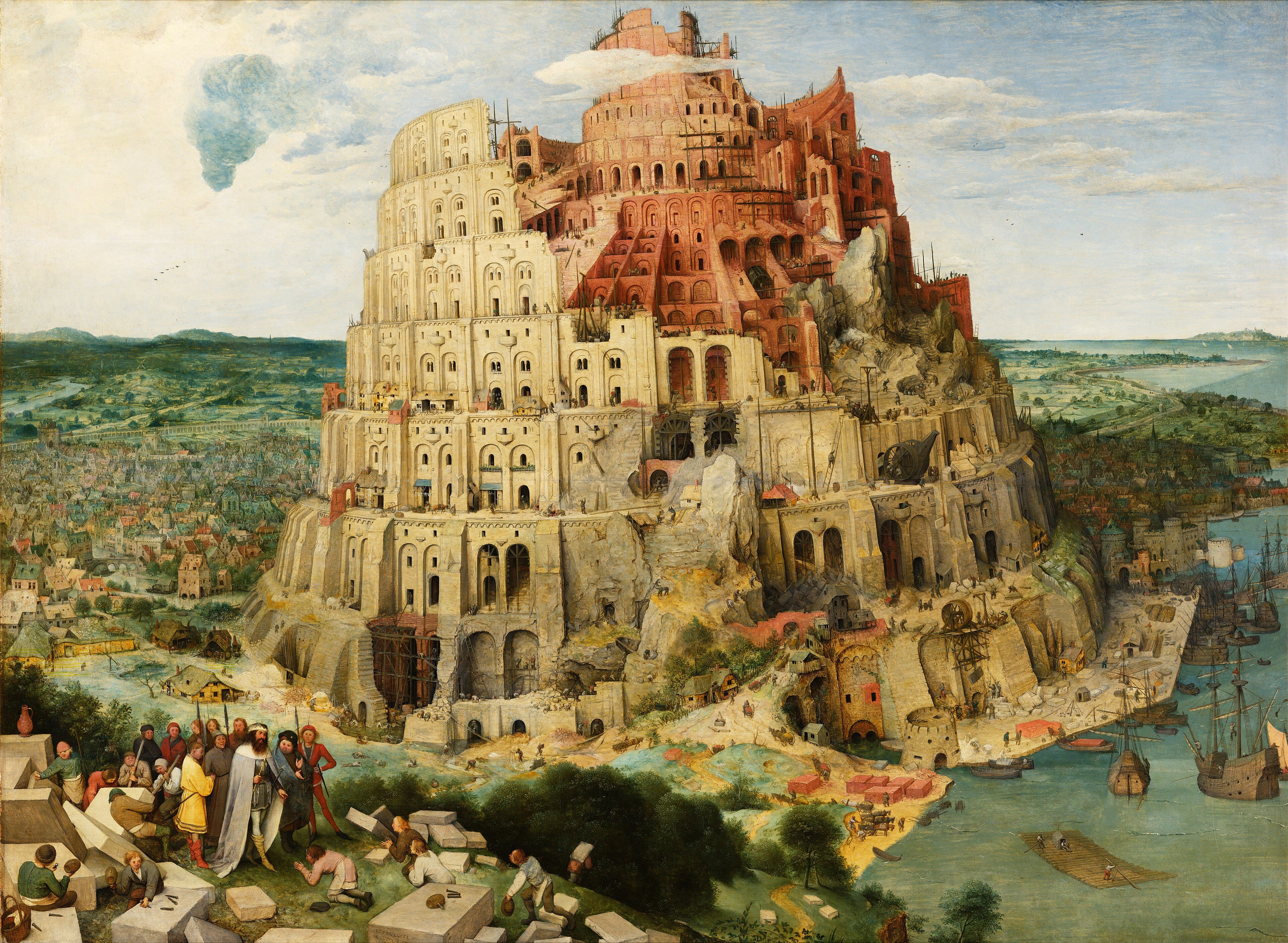
Our opening move toward a phenomenological approach—examining values as felt force fields in humanity’s lived experience—meant to recenter values, and to expose the gaping chasm between lived and nominal values: a chasm of baseless moral condemnation, hypocrisy, and propaganda with consequences for our political, economic, ethical, cultural, and ecological lives. Values orient humans in the world, and the distinction between lived and nominal values reveals the dangers of reducing values to abstract ideals, however well-meaning, on the one hand, or of taking our values for granted, thereby losing their potential malleability, on the other. Before we resolve the tension this opening move created, let’s restate some of its implications:
Values structure motivation.
Values are influenced by our needs and desires.
Values underlie our stories about the world (giving them directionality).
Values flow from many sources.
Our values have been shaped by a bio-evolutionary process.
Our values have been shaped by a contingent historical process. That is, not only our nominal, but also our lived values.
Values may differ by class, and other sociocultural contexts and constraints.
Values are impacted by trauma, which is reproduced systemically and intergenerationally.
Our values shift as we mature, hinting at their developmental character.
Even across communities with fundamentally different narratives about the nature of reality, value alignment may enable coexistence and even collaboration.
Our values can lie, unexamined, in the “basements” of our psyche. Illuminating the room can provide clarity and even reveal a doorway into a process of clarification: where did our values come from? Where do they carry us? Do we wish to change them, thereby fundamentally altering our orientation? Can we? Only by first addressing the descriptive aspect might we soberly approach ethics, virtues, and ideals.
And among all these considerations, there still lies a glaring question: what are values, really? Are they objective phenomena existing independently of the human subject, or do values exist only as subjective preferences or contrived norms within the human individual and culture?
Values, between Subject and Object
Premodern, Christian Europe inhabited a cosmos with objective values, disclosed through divine revelation and preserved in Catholic dogma. Modernity retained the notion of objective values, but rather than being received through revelation, they were deduced by the superior reasoning of the Western intellect, freed from dogma, birthing our “rational” modern values. In postmodernity, this pseudo‑objectivity of the Enlightenment was deconstructed, its roots exposed as stemming from a particular cultural context with its own quirks and blind spots. Given that the way toward divinely revealed or rationally deduced values was barred, the path to objective values independent of human subjectivity seemed lost, and the West became stranded in a postmodern archipelago of arbitrariness and relativism.
In the post‑postmodern space, we saw several attempts to confront the postmodern critique and resolve this tension between value subjectivity and objectivity. We saw the anti‑modern approach that espouses a return to perennial objective values (Traditionalists). We saw the modernism-rehabilitating attempt to ground values in the intersubjective field of communal sense‑making (Habermas). We saw the integral/developmental approach, creating an objective value map experienced differently as a function of maturity (e.g., Spiral Dynamics). We saw the suggestion of an evolving perennialism, making values objective yet a moving target (Temple), and an attempt to see values as transjectively fashioned (between subject and object) from an indeterminate yet real mystery (Ferrer).
These diverse approaches (among others) navigate the tension between value subjectivity and objectivity. Some of them venture into ontology by positing, challenging, or speculating about the nature of values and reality beyond the human subject. None of them provides what we have set out to find in this series: a meta‑map of values.2 Such a meta‑map must provide common ground for all value systems, even amid ontological and metaphysical disagreements, while somehow addressing the tension between objectivity and subjectivity. It must recognize the complexities we have named—the entanglement of values with needs, traumas, development, and sociocultural contingencies, contexts, and constraints, and the depth of values below the shallow, declared surface. With phenomenological methodology, we can hold these complexities while bracketing the ontological questions that surround them. This agnostic approach releases our findings from any ontological commitment.
With all these considerations before us, we are ready to lay out a meta‑map that can serve as a shared framework for any and all value systems.
Value Harmonics
The Western Enlightenment saw European philosophers break free from Christian dogma to establish rationally derived value systems to underpin a new, rational era for a newly rational, modern humanity. The project most emblematic of this thrust may be utilitarianism. English philosopher Jeremy Bentham (1748-1832) proposed a hedonic calculus of pleasure and pain to which values, and hence morality and ethics, could be reduced. This powerful idea implied that values could be quantified and, through a rational, impartial system, optimized at a societal scale, to “maximize” value.
But in Bentham’s utilitarianism, we see genuine cause for concern in leaving the objective, communal values of the Church. If each subject is led by their perceived desires, would we not devolve into a “pig society” where everyone pursues base thrills and pleasures for immediate gratification? John Stuart Mill (1806-1873) attempted to resolve this issue by separating higher and lower pleasures. Also a utilitarian, Mill remained committed to Bentham’s notion that all values, morality, and ethics can be reduced to the pleasure principle, but added that there are qualitative, not merely quantitative, differences among kinds of pleasure. Mill placed the pleasures of the intellect, imagination, moral sentiment, and aesthetic appreciation above the baser enjoyments of the body.
Incommensurability
But if some pleasures are categorically higher than others, how can they still be compared on the same scales? Did Mill not contradict his own allegiance to utilitarianism by adding this nuance, that some forms of pleasure are somehow “better” than others? This tension was finally addressed by Isaiah Berlin (1909–1997) through the concept of value pluralism. For Berlin, there are ultimate human values (liberty, equality, truth, etc.) that are all distinct and cannot be reduced to or compared on a single axis. Berlin’s value incommensurability refutes the utilitarian notion that values can be reduced to a flat equation (and delegated to technocratic governance *cough*).
Berlin’s value incommensurability recognizes an irreconcilable tension between different nominal values (e.g., justice versus compassion; freedom versus altruism). This tension may be necessary, and perhaps even productive, but it confirms insoluble conflicts between different value systems, with ideological allegiances to differing value hierarchies. Berlin’s intuition of incommensurability seems insurmountable. Rather than refuting it, we suggest that the incommensurability actually goes one layer deeper than the nominal values Berlin had in mind, into the value dimensions that underlie any and all value systems.
Value Dimensions

Nominal values are like the heroes of ideological myths, composites of simpler elements. These elements are what we are after, and so we seek the value dimensions themselves. This approach resurfaced repeatedly in the history of Indo‑European thought. Consider Plato’s tripartite model of the soul, discussed in Chapter 3 of Part 2. In Plato’s Republic, Socrates attempts to map the soul by examining the different classes in a hypothetical, ideal society. There, Plato presented the triad—eros, bodily pleasures; thymos, ambitious pursuits; and logos, wisdom and truth. We suggested that by capturing the different value orientations in a stratified society, Plato uncovered three different dimensions, or fields, of value.
It is not implausible that Plato was influenced by Eastern thinking, especially through his teacher Pythagoras. This is one way to explain the uncanny resemblance between Plato’s model and Indian thought. For instance, the model of the mind of yogic psychologist Sri Aurobindo (1872–1950), in which the mind has three aspects: a physical mind, concerned with physical things; a vital mind, concerned with one’s life path, plans, will to power, or possessions; and a thinking mind engaged with abstract thought and universal principles.3 These are tied to the ancient concept of the gunas: tamas, rajas, and sattva,4 which closely correspond with Plato’s tripartite soul.
By expanding value discourse to encompass both nominal and lived values, values in both the normative and descriptive sense, we recognized that values interpenetrate the human landscape of motivation. This brings us to Abraham Maslow (1908–1970), who was interested in the psychological motivations of “healthy” human beings—those seeking and driven by self-actualization, as opposed to those neurotically attempting to alleviate an inextinguishable sense of lack. Maslow identified distinct types of needs that underlie human motivation. These evolved throughout his work:
Physiological (1943) - Biological survival
Safety (1943) - Security and stability
Love/Belonging (1943) - Social connection
Self-Actualization (1943) - Personal potential
Esteem (1943) - Recognition and self-worth
Cognitive (1970) - Knowledge and understanding
Aesthetic (1970) - Beauty and harmony
Self-Transcendence (1971) - Service beyond oneself
Placed alongside Sri Aurobindo and Plato’s models, these can be seen as a different way of cutting the same cake. Another was proposed by German philosopher Max Scheler (1874-1928). Scheler, too, worked on a phenomenological approach to values, following his teacher and the father of phenomenology, Edmund Husserl (1859–1938). Scheler was also influenced by, but unhappy with, Immanuel Kant’s hyper-rational approach to values, as if they were derivable, or created ex nihilo from rational propositions. Scheler argued that values can be perceived and don’t need to be invented. Through his phenomenological approach, Scheler drew out the following value-dimensions hierarchy:
Religious (holy/unholy)
Spiritual (beauty/ugliness, knowledge/ignorance, right/wrong)
Vital (health/unhealthiness, strength/weakness)
Sensible (agreeable/disagreeable, comfort/discomfort)
In Plato, Scheler, Aurobindo, and Maslow, we see the recurrence of multiple dimensions of value. We also see correspondences among these dimensions, as is to be expected, since they are all attempts to slice the same (human) cake.
When we consider incommensurability, we see it may be problematic to arrange these value dimensions in a hierarchy. In other words, fulfillment of one value dimension does not alleviate the need presented by another. Scheler’s hierarchy reads like a phenomenological elaboration of Mill’s differentiation between higher and lower pleasures. Neither accounted for incommensurability.
Scheler grounded his Hierarchy in the phenomenological exploration of values, leaving open the door to higher, aspirational, and spiritual values that transcend the individual. But incommensurability is more evident in Maslow’s model: no amount of cognitive fulfillment can compensate for a lack of belonging; no amount of safety can compensate for a lack of self-worth, etc. These are separate, independent needs. For Maslow, it was clear from clinical and everyday observation that severe deficits create prepotency: lower needs dominate until reasonably satisfied. Through the prepotency of a set of semi-sequential needs, Maslow drew closest to a value meta-system.
Maslow had his naturalistic humanism assumptions and allegiances, like Scheler had his Christian ones, as they worked out their systems. An agnostic map would have to straddle the advantages offered by both. A post-postmodern meta-system would also need to provide a more robust and comprehensive treatment of trauma and development, as well as the role of nominal values in conjunction with needs. We shall now present such a meta‑map. One that ties all these threads together. Rather than conjuring some novel model that meets all these considerations, we shall use an existing map that, when repurposed, potently fits all these conditions.
The Chakra System
New Age oversimplification, on the one hand, and skeptical, offhand dismissal, on the other, may have turned this insightful system into one of the most underestimated diagrams circulating on the internet. We will argue that this oft‑misunderstood system, when treated as a phenomenological map, can act as an agnostic, post‑postmodern meta‑system of values. It is an effective Rosetta Stone of values.
What are chakras? Literally, chakra can be translated as “wheel.” Chakras are alleged wheels of energy, or energy centers. More technically, the chakras are supposed plexuses of nāḍīs—subtle energy channels in the human body. Each of these centers supposedly corresponds to a particular aspect of one’s life and “energy,” and will “open,” “close,” or “spin faster” based on one’s way of being in the world.
Beyond India, analogous systems were developed across cultures as far apart as those of Mesoamerica, Africa, and China. The seven‑chakra map most familiar in the West is a modern synthesis, rooted in a Śaiva six‑plus‑crown ladder attested in texts such as the Kubjikāmatatantra (c. 9th century) and Ṣaṭ‑cakra‑nirūpaṇa (c. 16th century). This systematization has earlier roots in Upaniṣadic and Āyurvedic notions of the heart‑lotus, navel‑wheel, and nāḍī junctions.5 It is both descriptive and prescriptive. More broadly, there is considerable variation among chakra maps used by yogic practitioners for soteriological purposes (i.e., spiritual attainment through advanced meditation techniques). The modern New Age seven‑chakra synthesis has its own peculiar history, passing through Western translators, reinterpretors, syncretic synthesizers, and, significantly, phenomenological practitioners. In other words, this map is rooted in ancient phenomenological traditions, but is a contemporary synthesis, arguably making it a living tradition.
That being said, though there is general consensus on this map among many modern practitioners, it is clearly not as “regulated” an environment as, say, modern science or academia.6 As such, the map must be approached carefully: neither accepted religiously as New Age dogma nor dismissed offhandedly by modern skeptics. Beyond these two arguably crude attitudes is a third group that considers this map with careful curiosity—skeptically but open‑mindedly. This third group includes psychologists, medical researchers, phenomenological practitioners, and, starting now, axiological philosophers. We invite you into this third group, as we are about to treat the chakra system seriously, if carefully.
And so, though there are many chakra systems, we will use this modern synthesis, syncretically informed by Western psychology and arguably updated for the modern psyche and life circumstances. The 6+1 chakras are, from the bottom up:
Root/Muladhara - Red
Domain: survival, security, grounding
Location: base of the spineSacral/Svadhisthana - Orange
Domain: emotions, sexuality, creativity
Location: lower abdomenSolar Plexus/Manipura - Yellow
Domain: power, will, ambition
Location: solar plexusHeart/Anahata - Green
Domain: love, compassion, interconnection
Location: heartThroat/Vishuddha - Blue
Domain: communication, truth, expression
Location: throatThird Eye/Ajna - Indigo
Domain: intuition, perception, insight
Location: between the eyebrows, pineal glandCrown/Sahasrara* - Violet
Domain: consciousness, spirit, enlightenment
Location: top of the head
* The seventh chakra (the “+1”) is different from the others in purpose and function. More below.
Are chakras real? We have a long history of post‑mortem examinations in the West, and no mortician, to our knowledge, has reported colorful discs of energy spinning in a human cadaver. This is the limit of modern science’s capacity to shed light on the matter. Under materialistic, positivistic assumptions (those of modern science), chakras are often dismissed as a scam of would‑be “gurus” hocking their superstition on lost children of the West for a quick buck or some attention. Clearly, more sophisticated experiments can be conducted to determine physical, electromagnetic, chemical‑hormonal, subjective, and other correlates of these hypothesized centers (indeed, such experiments do take place, mostly without the institutional support of systems committed to materialistic ontology).
Still, though: are chakras real? Excuse us as we sweep this question under the rug (right next to God). Mind your step around that lump that keeps forebodingly growing as we continue dancing around ontological questions.
Rather than relating to the chakras in a literal, objective, even physical sense, many modern Western scholars have interpreted them as psychological symbols. Such an attempt was first made by Carl Jung in the 1930s. A comprehensive study was conducted by Anodea Judith in Eastern Body, Western Mind in 1996, associating each chakra with existential questions, developmental stages, psychological correlates, and various other correspondences, including esoteric and speculative ones. More recently, the chakras have been correlated with contemporary psycho‑developmental models.7 These are only a few select examples. The chakras are occasionally recognized as an insightful, if ancient, schema of the human psyche, applicable even to modern Westerners and useful in conjunction with Western methods.
Here, we have a slightly different use in mind.
The Chakras as Dimensions of Value
We suggest that the chakras disclose incommensurable dimensions of value. Each chakra describes a distinct existential dimension for individuals to navigate and for societies to regulate. The chakras, as a phenomenological map of value dimensions, present a universal structure experienced differently by each person—an objective map of unique subjectivities. This ontologically agnostic meta‑map powerfully accounts for both development and trauma. As we shall see, using it in this way does not yield a static value system that prescribes how one should live or how our society should be organized, but only discloses the value dimensions that any such value system must consider. Let us review the chakras more closely.
The Root Chakra - The Physical Value Dimension

The first dimension of value concerns managing the purely physical: survival and procreation (procreation relates to the survival of the species).
As a dimension of value, this one is straightforward. Our salience landscape, our experience of reality, can take a dramatic turn in situations of immediate danger. This value dimension may assert itself, superseding all others, when survival is at immediate risk.
More broadly, the root can be associated with one’s subjective sense of safety—food and shelter, or, in the modern world, money for food and shelter. And taxes. And the bills. And debt service. Etc. There is, therefore, a whole dimension of value implicit in our being embodied beings who depend on the integrity of our bodies. It presents a fully self‑consistent value dimension for human beings (or any organism) to navigate.
The Sacral Chakra - The Emotional Value Dimension

But beyond mere survival and safety, another dimension of values opens up to the human being. It centers on pleasure but, more broadly, can be understood to encompass both emotion and sensation.
Perhaps utilitarianism, as expressed by Bentham, can be seen as reducing all dimensions of value to this single matter of pleasure and pain. Through the logic of this value dimension, things that bring us pleasure or joy are perceived as valuable, whereas those that cause discomfort are “negative values” we steer away from.
The Solar Plexus Chakra - The Power Value Dimension

Power and ambition, the thymos of the warriors: willpower and respect. Acclaim in battle or success in business, politics, sports, or whatever other social game humans use to compete and compare themselves to one another. Power presents its own logic and is an incommensurable value dimension. We value sovereignty, freedom, the capacity to impact the world around us, and an esteemed position among our peers.
Power and ambition may relate to survival under certain circumstances, they may dictate how much pleasure one has access to within a social context, or influence how one feels about oneself. Incommensurability does not imply that the dimensions are unrelated, only that they cannot be reduced to one another. The thymotic drive for power presents its own existential playing field among human beings, one that cannot be reduced to pleasure and pain or to mere survival. For instance, one may choose to accept discomfort in striving toward one’s ambition.
The Heart Chakra - The Love Value Dimension

What form of value is disclosed by the heart—by the force of love itself? This dimension seems to be different from the previous ones. It may even reverse their self‑serving logic.
The heart can be said to extend a subtle circle. The more “open” the heart is, so to speak, the larger the bounds of one’s zone of care. As such, rather than addressing purely extrinsic value (how something may be valuable to oneself), the heart discloses intrinsic value.
What does and does not carry intrinsic value? The logic is universal, but the perception is subjective. Does one care only for oneself? Or for one’s family? One’s friends? One’s race or nation? Even, perhaps, the entirety of humanity? How about birds? Or bees? Trees? Rivers? The Earth? Venus? Where does our recognition of the intrinsic value of things end, and their perception as valueless or merely extrinsically valuable begin? This is all determined and disclosed by the heart, with its own logic of value, incommensurate with the other dimensions, while intricately interplaying with each.
The Throat Chakra - The Expression/Communication Value Dimension

We value being able to express ourselves and to be “seen,” acknowledged, and witnessed in our human experience. We are affirmed, intersubjectively, in relationships with others.
As a social species, this value dimension relates to the existential need to verify and stabilize the validity and worth of our experience within a network of other conscious, social beings. This dimension relates not only to outbound but also to inbound information. As such, it is the dimension most closely related to the creation and appreciation of beauty and art.
As Habermas suggested, communication implies certain things. For him, this was the need for mutual understanding. We extend this notion to the need for transformation. Communication is a means to affect change in others, in the intersubjective field, and in the human world at large. Not only the crude force to push another to do one’s will, but the subtler power to influence another being from the inside out. Communication is our means of shaping and changing the social world we inhabit. This is the social value dimension of expression, disclosure, mutual recognition, and beauty.
The Third Eye Chakra - The Knowledge Value Dimension

The human pursuit of knowledge, wisdom, and Truth for their own sakes discloses its own incommensurable dimension of value. The notion of a “third eye” gives this dimension an esoteric air. This may be appropriate, given that it also relates to more esoteric ways of knowing, such as intuition. It is doubly appropriate, given the insurmountable task of human knowledge vis‑à‑vis the infinite, ineffable mystery that surrounds human existence.
This dimension’s incommensurability implies that one may risk safety, comfort, power, and social standing in the pursuit of Truth—or, alternatively, sacrifice Truth to maintain one’s stable ground. Regardless, these dimensions cannot compensate for one another. The knowable‑unknown exerts pressure on us to learn, grow, and become, at the cost of sacrificing all kinds of self‑deception.
This dimension is somewhat sidelined in modern society. It is, at best, optional. It may compel one toward scientific and academic pursuits (or philosophical, spiritual, or any independent quest toward truth), but is otherwise sadly absent from the lives of the vast majority of those who make up the body of the modern economy. At the very least, this dimension is accessible, in some forms, if marginalized, in modernity.
The Crown Chakra - The Spiritual Dimension of Value

The crown chakra is entirely spiritual. It sits opposed to the root chakra, which is entirely physical.
This dimension is even more esoteric than the previous. Being a spiritual dimension, our hands are somewhat tied in fleshing out its implications, so long as the ontological and the metaphysical remain under the carpet. However, even without attributing any objective meaning to it, the crown can be recognized as disclosing subjective states and values through our phenomenological lens.
The crown is associated with spiritual states of consciousness (and higher stages of development). If spirituality is, metaphysically speaking, nonsense, then this dimension only refers to nevertheless undeniable subjective experiences of such states. This is a rare value dimension central mainly for mystics, arhats, and saints—either spiritual seekers or finders.
The crown is the “+1” in the 6+1 system. Unlike the others, which are considered fields to balance in the tantric model from which the modern system derives, the crown is set apart as the outcome of said balancing. It is not meant to be pursued independently, which would suggest an attempt to escape embodied human life in favor of spiritual release—something of an existential confusion.
For now, we will leave it at that. With metaphysics swept under the rug (watch your step), we can only report on this dimension as subjectively experiencable.
Why this Map?
Any sufficiently robust phenomenological map of incommensurable value-dimensions could, in principle, serve the purpose we are describing. The chakras arguably constitute a comprehensive set, given the many generations of phenomenological practitioners who have put them to use. Beyond being a comprehensive set, the chakras offer further structural advantages that bring together all the considerations that emerged in this series. These, any alternative map would have to address. Let’s examine how the map addresses these.
Valueception, Revisted
Throughout this series, we used Scheler’s concept of valueception (German: Wertnehmung). Scheler treated valueception as the capacity to recognize intrinsic value. We associated this level of valueception with the heart chakra. This means, as we have previously alluded, that there are various other kinds of valueception. Each dimension of value disclosed by the chakras presents its own logic, implying that there are those with, and those without, the eyes to see each one.
Scheler rightly emphasized the non‑trivial capacity to recognize intrinsic value as such. But we also add that not all are equally aware of the dimensions of power. The hidden power games that govern human society are largely opaque to many people, obscured by screens of propaganda (though the veil is becoming thinner). One who is blind to power as a dimension of value cannot empathize with nor see into the motivations (and machinations) of power players and elites. Closer to home, agency and sovereignty are seldom recognized and modeled in their healthy, mature forms in modernity, given that it is based on power hierarchies. Similarly, not all are as aware of the emotional fields to which all humans are subject and must navigate, and cannot “read the room,” and so on. These dimensions form layers of every social situation, every person’s life, and are aspects of society more broadly. We exist in a world with multiple dimensions of value that we may train our eyes to see and our skills to navigate.
Objectivity and Subjectivity, Revisited
Are values subjective or objective? Do values somehow pre‑exist the human subject, having some kind of independent existence in the cosmos? This is an ontological question that bears on the very structure of reality beyond values alone. Through phenomenology, we become acquainted only with the subjective side of values. But the meta‑map we presented reveals something significant about this subjectivity. Rather than a relativistic, amorphous, everything‑goes soup of passing whims and desires, our subjective experience of values appears to have an underlying structure. This structure implies a universality of experientiable values, defined by existential non‑negotiables that are part and parcel of embodied human existence as a biological, emotional, and social being, capable of love, and surrounded by the ineffable mystery. Yet this objective, universal structure is nevertheless experienced uniquely by each subject.
The dimensions of value are implied for any person to potentially perceive and experience, but this is not guaranteed. Not all humans will orient their lives toward Truth or wisdom. Not all humans will get to wield power, or even feel joy or the full gamut (and depth) of possible emotions. As Scheler and others note, not all perceive the intrinsic value of others. Some may live a life limited by survival needs or be constrained to a neurotic pursuit of safety or emotional well‑being, caught in a traumatic loop that they lack the skills, guidance, and role models to break out of. In this way, traumas may close off certain dimensions while making others supersalient. The elite’s pursuit of power, the billionaire’s compulsive need to outcompete, like the drug addict or excitement junky, falls into a reciprocal narrowing where one value dimension supersedes all others. Maslow proposed the prepotency of unmet needs, but through the chakra system, we can recognize that certain dimensions can lock into compulsive overactivation based on perception, and that trauma can also work to deactivate, not only hyperactivate certain dimensions (e.g., modern schooling traumas may deter one from intrinsically motivated learning).
Each of these dimensions presents its own kind of profound depth. No two people can be expected to experience any of the multiple dimensions in the same way. The chakras also interpenetrate and relate to one another in intricate ways that this short essay cannot fully explore. How is our emotional well‑being impacted by a lack of safety? How does the perception of intrinsic value alter our conception of power—ours and others’? How does knowledge of the dimensions impact our approaches? Though it presents an objective, universal model, the system is a universal map for irreducible subjective uniqueness. It thus bridges objectivity and subjectivity: no one‑size‑fits‑all, just one map describing all sizes.
Incommensurability, Revisited
Isaiah Berlin argued (convincingly) for the incommensurability of nominal values, contradicting the notion that values can be compared using some utilitarian arithmetic. What is disclosed when we apply this incommensurability to the value dimensions themselves?
Each of the dimensions can become supersalient or dormant, “under‑activated” or “over‑activated.” Rather than ranking the value dimensions through ideological commitment (which is still possible), incommensurability here implies the need to balance each dimension in turn. As in Aristotle’s golden mean, the opposite of hedonism—self‑denial, or asceticism—is not necessarily morally preferable, but is seen as the other extreme of imbalance. The chakras subvert the logic of more, with the logic of balance, fundamentally challenging modern value sensibilities.
The incommensurability of value dimensions implies that a full human life takes them all into account, with eyes trained to see each in turn. This kind of incommensurability contradicts the notion of a value hierarchy, as espoused, for instance, by Plato, Scheler, or J.S. Mill. For Plato, the logos should rule supreme. In the sense that there should be a reasoning principle governing our various parts with their particular wants and needs, this logocentrism is defensible. But this map reveals how sacrificing thymotic or erotic values for logoic values may become problematic. Rather than setting eros and thymos at odds with the logos, sacrificing “pleasure” or “power” for the sake of, say, “wisdom,” each can find its own balance and thus become less pressing. Each dimension implies a pathway toward its own balancing. The logos becomes a servant in finding balance for each value dimension in turn, and harmony among them, rather than demanding sacrifice that may invite further imbalance.
For example, rather than negating power‑lust by abdicating power, one may strive for a balanced sense of power—sovereignty, agency, confidence, and courage—that does not depend on lording over others or on external validation. Similarly, for those who crave pleasures (sweets, sexual gratification, “entertainment”), rather than attempting to suppress the underlying emotional pain and sense of lack that demands these distractions through moral condemnation, emotional well‑being is recognized as an independent goal in its own right. Were these dimensions commensurate, rather than incommensurate, it would mean that one could overcome their lack of assertiveness by studying French literature, or override the fear of death by stuffing their face with sweets, even filling up on trivia instead of food to maintain a healthy body.

Nominal and Lived Values, Revisited
The chakra map does not tell us how to live, nor how to reorganize our societies. But it does reveal certain things we may take into account. It reveals universal dimensions of value that stem from existential non‑negotiables implicit in human existence. How, then, do we choose to navigate these dimensions individually? How do we regulate them societally? This is where nominal values come into play.
Nominal values—e.g., justice, equality—are ideas about how we should organize our individual and collective lives. They are value constructs. Never, in this series, have we rejected ideas and ideals. Rather, we insisted that we need valueception to recognize the different dimensions that nominal values attempt to regulate and navigate. A value system consists of a set of nominal values, often ordered hierarchically or internally related. In other words, a value system is a structure of ideas. We must acknowledge the necessity of nominal values—ideas about how we should govern and regulate the different value dimensions—seeing that the underlying value dimensions themselves describe a landscape open to choice and interpretation.
But though the chakras are quiet, they are not silent. This meta‑map reveals how different value systems may reject or favor one dimension over another, even be entirely blind to some. If we apply this map to our historical narrative, we can see that somewhere in the past, societies arose based on power imbalances (power hierarchies) and “closed their hearts” (by shifting from intrinsic to extrinsic valueception of Nature and humanity), and that they curtailed any public discourse or pursuit of truth that would threaten to destabilize the social order. We also saw that many of these early decisions linger in the “genome” of Western societies to this day.8 While we cannot, based solely on this theory, say that these societies were wrong in a quasi‑objective way, we can say that their value systems may be imbalanced or partially blind, and analyze the costs and benefits of their approaches across multiple dimensions of value. Historically, value systems enshrined and institutionalized preexisting assumptions and preferences regarding the underlying value dimensions.
In modern democracies, demagogic politicians and other powers create and then utilize fear to mobilize societies for their own ends. They reduce the multidimensionality of value to the supersalience of safety, promising or requesting power to destroy the danger, be it the other (e.g., Arab, Russian, Persian), dehumanized through a denial of intrinsic value, or some more abstract enemy like terrorism, immigration, pandemics, scarcity, etc. Putting aside the legitimacy of such claims, incommensurability reveals why mobilizing a society on safety concerns alone is both highly effective (safety is “the root” and the foundation) and problematically reductive. It flattens a nuanced, multidimensional situation by leveraging collective traumas and anxieties. This sort of emotional manipulation is the first tool of any aspiring demagogue. It is countered by the recognition of the irreducibly multidimensional nature of value.
Whatever value systems we construct moving forward, they can be built with recognition of the multiple dimensions of value, so that future generations may access the fullness of human potential. And even beyond mere human potential, intrinsic valueception leads us to question the anthropocentric limitations of humanism as such.
Intrinsic Value, Revisted
The heart chakra—in our articulation, the dimension of love—governs the boundary up to which intrinsic value can be recognized. In hyper‑individualistic societies such as modernity, with communities fragmented into “nuclear families” living in isolated concrete cells, one’s circle of care shrinks to a handful of people vis‑à‑vis the rest of the world.
By recognizing this heart dimension underlying any value system, we can see that a society’s value system, spoken or otherwise, always sets an implicit policy in this regard. In Christian Europe, for instance, enslaving non‑Christians was permitted. It is often argued that in patriarchal societies, women are objectified, though it should be added that the men of such societies are also objectified, albeit differently. And, for millennia, humanity has been unquestioningly objectifying animals and plants for extrinsic value. This modus operandi reached a kind of zenith in modernity. Is this wrong or right? The meta‑map itself, in its agnostic formulation, is silent. It only presents this dimension as such, leaving the existential deliberation to us.

Comparative Analysis
We presented the meta-map and discussed how it makes sense of the different considerations of this series. How does it relate to the major currents of value theory in Western academic thought? By tracing that tradition, we can see both where it independently arrived at comparable territory and identify what it traded away in the process. As Western Europe dis-embedded from a Christian universe, where values flowed from the grand narrative of Christian cosmology, the thinkers of the Enlightenment were attempting to re-ground ethics in a world divorcing from God. Alongside the utilitarian project was Immanuel Kant’s (1724-1804) seminal project. Kant drew hard lines between a realm of nature (what is) and a realm of freedom (what ought to be). Kant cordoned off value as a separate domain of rational agency and cast metaphysics as unknowable.
Post-Kantian German Philosophy
After Kant, Georg Wilhelm Friedrich Hegel (1770-1831) proposed a grand metaphysical vision in which nature, history, mind, ethics, art, religion, and philosophy were all moments in the self-development of Geist (mind or spirit). But Hegel’s attempt at reconciling matter and spirit frayed in the following generation, with the split between Left and Right Hegelians (where should spirit go as history unfolds?) and the relentless advance of the material sciences, in light of which speculative metaphysics seemed superfluous. The supposed failure of this last great attempt at a metaphysical superstructure led German philosophers to attempt to recover value in a world devoid of metaphysics.
Hermann Lotze (1817-1881) was the first to respond by making value itself the object of philosophical focus. He accepted Kant’s separation of fact and value but refused to let value collapse into mere subjectivity. Values do not exist the way physical objects do; they hold or are valid. Wilhelm Windelband (1848–1915) built on this insight to articulate the fundamental distinction between the natural and human sciences. The human world is “moved” by value-laden meaning. Wilhelm Dilthey (1833-1911) arrived at similar conclusions. For him, human life is not an object to be explained causally (Erklären) but an expression to be understood from within (Verstehen). The primary categories of the human sciences were not cause and effect but purpose, value, and meaning. Franz Brentano (1838–1917) opened the experiential dimension with his thesis of intentionality, arguing that all mental acts are directed toward an object. Brentano influenced both Edmund Husserl’s (1859-1938) phenomenology and Scheler’s.
Into Psychology
A student of Dilthey, Eduard Spranger (1882-1963), took Dilthey’s descriptive approach to human life and asked: What are the fundamental orientations through which a human being relates to the world as meaningful? Spranger was using a hermeneutic approach to extrapolate from the reading of the life-biographies of actual, particular persons. He identified six distinct types of value sensibility—economic, social, political, aesthetic, theoretical, and religious (note the strong correspondences with the chakras: economic—root; social—sacral and heart; political—solar plexus; aesthetic—throat; theoretical—third eye; religious—crown).
Psychometrized
American psychologist Gordon Allport (1897-1967) read Spranger and Dilthey, and, following independent trends in psychometrics, “operationalized” Spranger’s system. Allport placed value at the core of personality and, alongside British psychologist Philip Vernon (1905-1987), used Spranger’s categories to co-develop the Study of Values (SOV), the first psychological instrument for measuring personal values, which was later revised by American psychologist Gardner Lindzey (1920-2008). The SOV was one of the most widely used personality instruments in American psychology for decades.
Influenced by Allport, Polish‑born American social psychologist Milton Rokeach (1918–1988) differentiated between terminal (desired end-states) and instrumental (desirable modes of conduct) values, and created his value survey, in which two lists of 18 terminal and instrumental values were rank-ordered by survey participants to determine their underlying value hierarchies.
This was the line of thinking from German Philosophy and into American psychology. It began as a Neo-Kantian attempt to rescue value from dismissal or reduction by reason. For the Neo-Kantians, though meaning and value may not be measurable physical objects that can be generalized through universal laws, they are still undeniable in the inner experience of persons. This culminates in Scheler’s phenomenology of values and his value hierarchy. As this impacted psychometrically inclined post-war American psychology, values become measurable substances, as if to complete a full circle. Values became, once more, real things to discover, but rather than through phenomenological exploration, this was done through psychometric surveys.
From Sociology and Anthropology
Alongside the strand from German philosophy to American psychology and psychometrics, two more strands, studying societies, rather than individuals, fed into contemporary theories of value: sociology (the study of modern societies) and anthropology (the study of cultures more broadly). Straddling both of these fields, American social theorist Clyde Kluckhohn (1905-1960) saw values as a functional glue that binds societies together, while holding the anthropological stance of cross-cultural relativism. He theorized that while cultures differ in the contents of their values, these values must all respond to the same set of universal existential problems imposed by the human condition (similarly to our own approach). He theorized that every society must deal with human nature, the relationship to nature, time orientation, modes of activity, and the structure of social relations.9 This was later formalized into the Values Orientation Theory (VOT) by his wife, anthropologist and sociologist Florence Kluckhohn (1906–1986), and sociologist Fred Strodtbeck (1919-2005).
Schwartz’s Theory of Basic Values
The thread from German philosophy and into psychology, and the threads from sociology and anthropology, weave together into a contemporary value theory authored by Israeli social psychologist Shalom H. Schwartz called the Schwartz Theory of Basic Values.10
Schwartz took Rokeach’s list of values and sought an underlying structure among them. He took Kluckhohn’s notion of values deriving from existential dilemmas for human societies. Schwartz developed two main instruments—the Schwartz Value Survey and the Portrait Values Questionnaire—to test the structure and cross‑cultural recurrence of ten nominal values. Schwartz models the continuities and antagonisms between his chosen list of values using the following diagram:
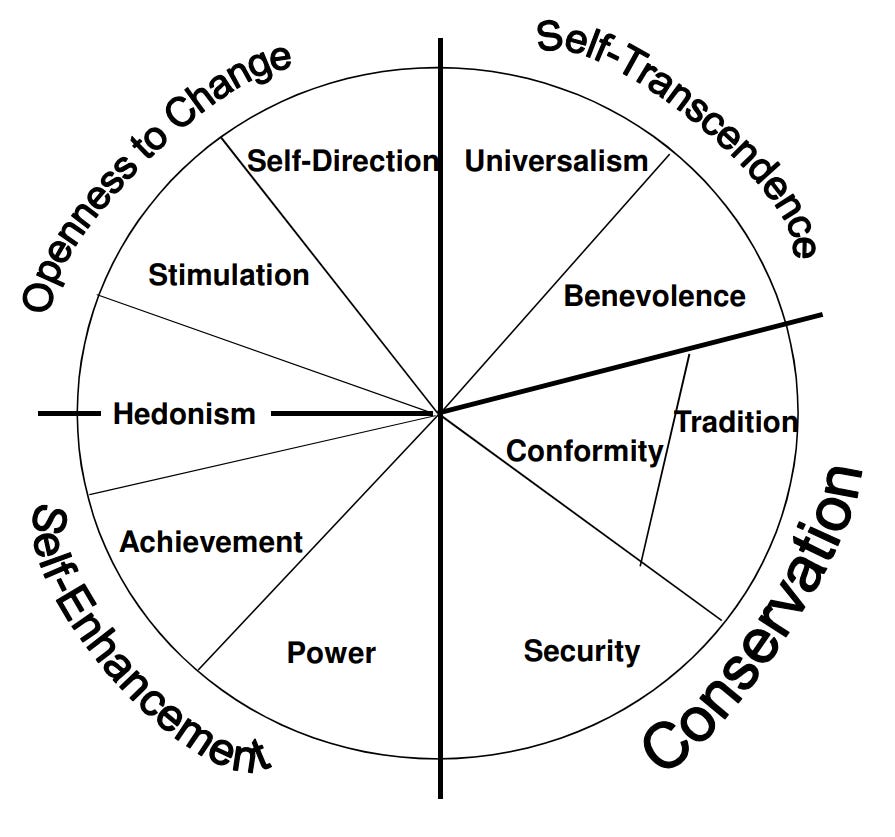
Schwartz’s model presents two axes: openness to change and social versus individual focus. These cluster together in survey results, across cultures. Of course, though there is a great variety across the cultures surveyed, they have much more in common. Cross-cultural surveys across modern societies cannot provide a truly universal picture of values, only a modern one. What the surveys do show is the distribution of values across modern societies, presenting profiles of value preferences that may be more informatively mapped onto the chakra map (note how the values in Schwartz’s reduction of Rokeach’s list correspond to the chakras).
Comparatively
In this series, we have attempted to disambiguate the discourse around values. Many of these ambiguities can be seen in the value discourse of the humanities and the social sciences. As we have seen, values straddle the tension between what is and what ought to be. That is, while values may outline a desired situation, perhaps existing as a future potential if not in present actuality, our values are also shaped by the past, by intergenerational traumas, socioeconomic conditions, and historical contingencies. This deeper developmental structure of our capacity to perceive values was lost somewhere along the attempt to psychometrize values. The ever-present risk was taking our given values for granted, losing track of the project to deliberately explore values as the underlying currents of society that guide humanity toward its future. This can be seen in Schwartz’s system, a synthesis of academic traditions that effectively maps value-system profiles in modern societies without comprehensively covering the dimensions of value.
We can trace this living exploration at least as far back as ancient Greece, where philosophers explicitly questioned the given values of their society and developed tools and methodologies for investigating values and the potential societies they implied. This exploration was suppressed and remained dormant in Rome and Christian Europe, to reemerge implicitly in the Renaissance and explicitly in the Enlightenment. It culminated in the Enlightenment's pure reason, free from dogma, which ironically coalesced into the new dogmas of modernity. Neo-Kantian German philosophy, and especially the phenomenologists, moved to recentralize the living investigation of value. This culminated in the works of Scheler and Maslow (especially in his later work), who envisioned ascending hierarchies of values that hint at untapped human potential vis-à-vis the present state of society.
What is lost in this value discourse is this potential, grounded in the recognition of the burning necessity for a living exploration and investigation into values as the justificatory basis for any and all human societies. Psychometrized value studies (Allport, Rokeach, Schwartz) examine the value distribution within modern societies, and we must not mistake these distributions for insight into the domain of value itself and the deeper questions it raises.
What is the purpose of civilization? Of society? Of the economy? Of political life? Of art or culture? To the extent that we take society's given values for granted, having lost the capacity for reflection, clarification, and reorientation, we, as a species, would have lost the plot. We would be reduced to automatons, following the motions of forces we lack the perception to recognize and the capacity to affect. Such a humanity would then proceed on blind inertia toward a future shaped by unexamined values, a predictable course culminating in extinction. The alternative is to ask again. What if modern society, in fact, does not have all the answers? What if we must inquire again and again, continuously, what do we value, and why? Toward what should we orient? What is the point of progress? What is the point of life, unmoored from a living exploration of what actually matters?
The phenomenological meta-map we have presented attempts to restore this living exploration. It provides no final answers, only a structural scaffold for any serious inquiry into what does and does not matter in lived experience. Unlike the psychometric tradition, the living exploration of value through phenomenology confronts the more difficult underlying questions about what actually matters, rather than what modern societies have come to prefer. Value systems as different as secular, liberal capitalist democracies, traditional Islamic theocracies, and indigenous horticulturalists can be placed side by side with their dimensional emphases, suppressions, and distortions made legible using such a framework. Our value systems can finally be put to the test, not on whether they are correct or justified by an absent deity or long-dead prophet, but on their internal balance, comprehensiveness, soundness, and harmony. Each dimension we elucidate and track can be protected from being lost amid the world's upcoming transformations as we navigate the unfolding metacrisis.
Conclusion
This has been a long‑form series about values. We name the value crisis at the heart of the metacrisis. Western culture has become accustomed to discussing values as abstract ideas. This created dangerous blind spots in the discourse on value, engendering confusion and moral condemnation where clarity, courage, and honesty are urgently needed. A phenomenological exploration reveals values as invisible force fields that move individuals and civilizations. The nominal values we construct hover over a preexisting reality of value dimensions. Nor can we simply take the preference distribution across modern societies as indicative of objective value structures or as a comprehensive map of the landscape of value. These have been shaped by a contingent history of cultural and socioeconomic forces and may cloud our capacity to perceive a fuller range of value dimensions (as well as the potential reforms they may spur us to choose).
The chakras, not as an ontological assertion about subtle energy bodies, but as a phenomenological map of existential multidimensionality, can serve to ground value discourse in its underlying complexities: the subconscious, trauma, psychological growth, sociocultural contingency, and an implied potential for balance and harmony across multiple dimensions of value and across varied value systems.
The agnostic, phenomenological form of the map means it can be applied to any value system, regardless of ontological commitments (say, to monotheism or to atheism). Each value system can be seen as a different strategy for navigating the same pan‑human situation. Thus, the chakra map is not a value system, but a value meta‑system. It gives us no final answers, only clarity on the underlying territory. Whatever we value is governed by the logic of these underlying dimensions. These structure our motivation and our attention. Applying the map to oneself, beyond mere self-taxonomy, one finds a powerful tool for genuine clarification, reorientation, and even healing.
The map we presented synthesizes considerations of value objectivity and subjectivity by drawing on phenomenological and existential currents in the Indo‑Western traditions of soteriology, philosophy, and psychology. But the chakra map is not, itself, the point. The chakras reveal certain dimensions. They slice the cake in a particular way. Other maps can be used in conjunction, and so long as the particular dimensions the chakras reveal are not forgotten, nothing would be lost in the process. Whoever may wish to dismiss the chakras as a meta-map of values must still reckon with the entanglement of values with trauma, development, and sociocultural circumstances.
Rather than push a particular system of thought, the point of this series was to ground value discourse, which became, in the West, unmoored. Our orientation in the world is affected by, but not limited to, the nominal values that societies, cultures, institutions, corporations, and people publicly declare. Values are a more multifaceted, involved, intimate, and tragic matter altogether. The chakra map demonstrates that it is possible to bring all these considerations productively into a single conversation without becoming lost in their interweaving complexity.
Some may object to the use of chakras for this purpose, preferring, perhaps, Maslow’s more secular and less esoterically inclined list, or some naturalistic‑evolutionary approach. We have used the chakras as a phenomenological‑existential map. In this way, we have focused on values as we humans sense and are moved by them in our direct experience. All the while, we have avoided the ontological questions that still hover in the background (including any concerning the chakras themselves). But is this truly a tenable position?
Ontological agnosticism brought us this far—up to a phenomenological map that discloses the underlying value dimensions—but no further. The map even presents a spiritual “crown,” yet we avoided asking whether the spiritual “kingdom” it points to is, in some sense, real, and not a mere delusion of smooth, storytelling apes attempting to alleviate existential angst by projecting deities onto the skies (and then using them for political manipulation).
We know that the perception of intrinsic value is a variable, and that it can extend very far or be limited to a small circle, but without knowing the ontological standing of animals and plants, how do we know whether we “should” extend our love toward them? If God exists, if “God is Love,” there may be significance to such questions beyond the subjective, fleeting experience of the individual. If the chakras are real as energy plexuses, then our subjective way of being would carry objective, physiological consequences. If animists or pantheists are right, then even rocks are conscious and worthy of some kind of respect. Is Nature intelligent? Or are the materialists correct, and all is inert matter? Were God to convey desires for humans to coexist peacefully or command a master race to conquer some holy land, would ontology not inform our values?
Such ontological and metaphysical questions bear tremendous significance for the contents of our value systems. By abstaining from these questions thus far, we were able to present an agnostic value meta‑system apt for any value system and any metaphysical commitment. But what of the contents of these systems? Our value systems reflect our stories about the nature of Reality. Our stories about human nature. It is true that different ontological starting points can lead to harmonious value systems (in practical terms, it may not matter if one who loves their neighbor does so because, say, they believe their neighbor has a soul). But different ontologies still do affect our values. The fact that there are virtuous atheists does not imply that atheism is as conducive to virtue as, say, Jainism. Secular and religious societies can converge on harmonious value systems using a unifying, agnostic meta‑map. But will they? Are our values not informed by our understanding of what is?
Metaphysics… Unavoidable
Alas, this series ends in failure. It may be impossible to get to the bottom of values while remaining agnostic. We can talk about values in the abstract, we can sense them in our own experience, but different ontological starting points would still tend toward different value systems.
But this is a “happy failure,” considering all that has been achieved. Our previous series, Simplicity Complicity, ended similarly, failing to self‑stand. Recognizing that stories form in accordance with our underlying values, which act as their teleological magnets, we set off on this journey to investigate the nature of values. In the process, we learned much about the complexity of the landscape of values and were even able to present a meta‑map of the value dimensions underlying all value systems. But so long as we ignore ontology and metaphysics, we can only say what the value dimensions are, not whether loving another, or loving plants, or aspiring toward wholeness, sovereignty, or the Truth, fits some cosmic plan. Should one strive only for the well‑being of one’s own small community? Or that of the species? Or of all life on Earth? How about mosquitoes? How about rocks? Or extraterrestrials? Knowledge of Truth may exist as an independent dimension of value, but why not ignore it in pursuit of power or pleasure? Ontology and metaphysics overflow from underneath the carpet. The next leg of the journey comes into view.
We are nearing the end of the first phase of this publication, where we establish foundational pillars stable enough to build on. This series and these early essays were written for those who aim for a more beautiful world through the process of death and rebirth that our society is currently undergoing. The world is transforming, with or without our participation. To steer this transformation toward a future actually worth pursuing, we require clarity and a shared language about the underlying dimensions of value. But even this, we sense, would not be enough.
Next on High Resolution, we will return to stories. But rather than continuing our exploration of stories as such, we move to investigate the foundational stories underlying all others: the metaphysical and ontological bedrock on which entire worlds rest, from pre‑ to post‑modernity. Uncharacteristically for High Resolution, a publication resolved to resolving things, we will be aiming for a slightly different outcome—an existential openness, the reclamation of curiosity and of wonder—more appropriate to the infinite mystery of what is.
Join us next time as we change gears once more to melt the ground beneath our feet and expose the roots of all misplaced modern certainty—matter itself.

May we gain the eyes to see
The hands to shape
Those forces that move us
May we find the courage to shift
The wisdom to choose
Our fates sculpted by desire
If we fix our broken compass
By mending torn sails
What unknown shores invite us
Heaven and Hell
A judgment call apart
Universal grammar of values is a term adopted from David Temple. See Part 3, Chapter 1 of this series.
The Spiral Dynamics (SD) model comes close. But SD maps value systems, whereas we are attempting to map the value dimensions that recur across them.
Aurobindo’s model has higher aspects that inspired the expansion of the Spiral Dynamics (SD) model into Spiral Dynamics integral (SDi), as noted in the previous chapter.
Though written evidence for these dates back to the late-Vedic period, around the 3rd century BCE, they may originate in pre-Aryan oral traditions. The gunas are three universal qualities: tamas is associated with inertia, heaviness, darkness, inactivity, ignorance, delusion, dullness, and resistance to change; rajas, with activity, movement, passion, and desire; and sattva is associated with harmony, balance, clarity, intelligence, wisdom, and goodness.
To trace the evolution of the contemporary map, see, for instance, Hatley, Shaman. (2025). The Wheel of the Navel and Lotus of the Heart: Metaphor, Medical Knowledge, and the Body of Early Yoga. Journal of Yoga Studies. 6. 221-257. 10.34000/JoYS.2025.V6.005.
This is not due to a fundamental impossibility to create a collective epistemological project around phenomenology. It has more to do with the West's sociocultural emphasis on power over the ‘external’ material world, rather than on knowledge of human ‘interiority.’
See, for instance: A Chakra System Model of Lifespan Development (2010) by Candis K. Best for a proposed chakra developmental model; or The Interplay Of Energy And Ego: Understanding Human Development Through Chakras And Erikson’s Theory (2025) by Dr. Vidya Hattangadi and Dr. Shilpa Shinde for a comparative analysis between the chakra map and Erik Erikson’s psychosocial development model.
Such social choices are based on universal value dimensions and are not unique to the West. Current academic consensus suggests that the hierarchical societies of China arose independently from Western influence. Independent developments occurred in the Americas prior to the arrival of colonizing Europeans.
Kluckhohn’s existential questions were framed as a continuum with pathological extremes and healthier middles.
What are people like? Good, evil, or capable of both?
What is society’s orientation toward nature? Subjugated to nature? Subjugating nature? Or harmonized with nature?
Which temporal horizon is primary? Past? Future? Or the present, here-and-now?
What is the right way to act in the world? Being (emphasis on inner state), doing (emphasis on external results), or being-in-becoming (cultivation and self-development)?
What is the basic, proper form of social relation? Hierarchical, individualistic, or collateral / group-oriented?
Putting aside the specifics of this formulation, note both how the existential questions themselves largely fall in line with the different value dimensions we enumerated and how Kluckhohn’s structure acknowledges types of excess as well as balanced, middle positions.
Schwartz, S. H. (2012). An Overview of the Schwartz Theory of Basic Values. Online Readings in Psychology and Culture, 2(1). https://doi.org/10.9707/2307-0919.1116. Also see The Values Map by the Common Cause Foundation for a quick introduction.